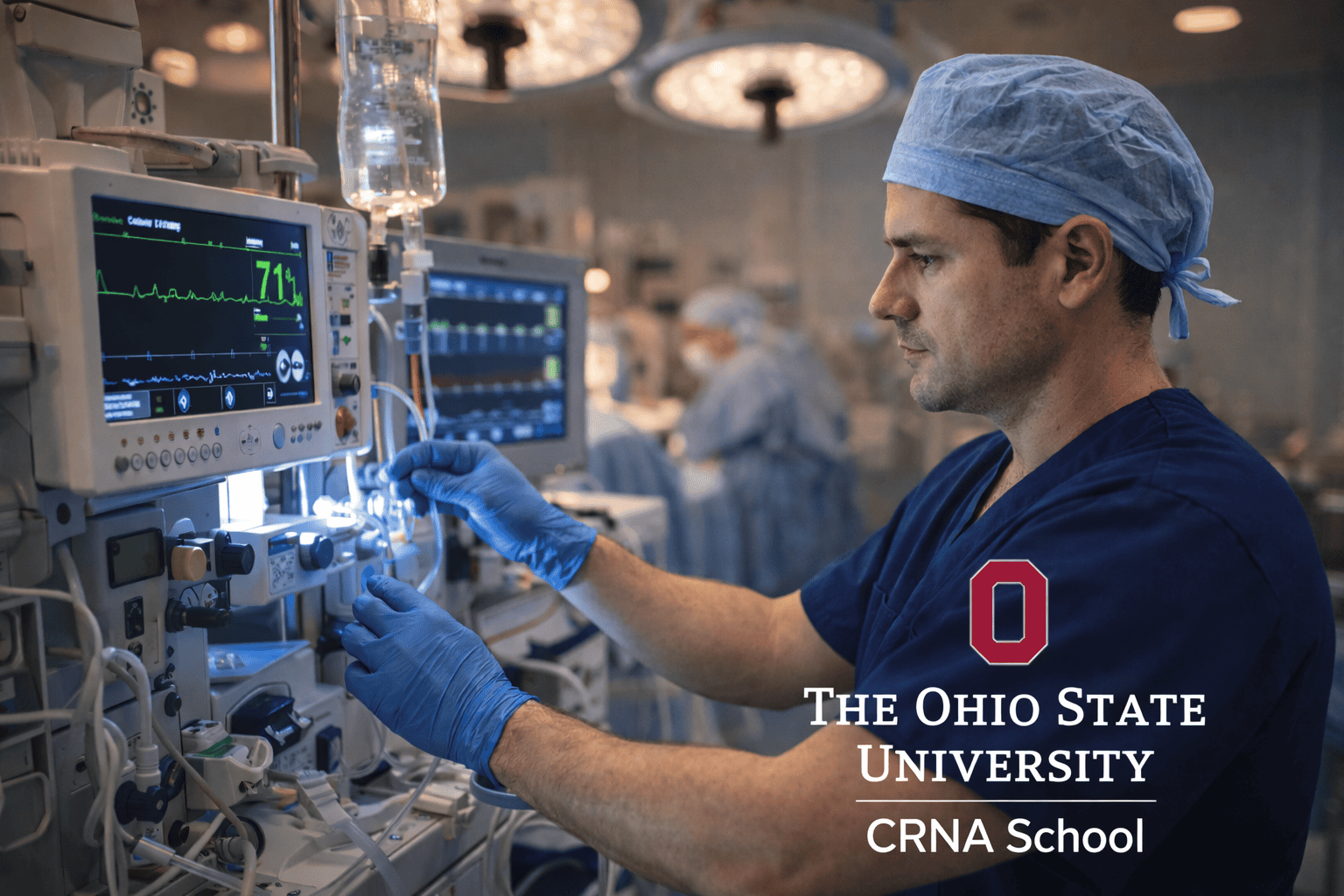
Ohio State University CRNA Program 2026
Last updated: January 2026
Here’s something that might surprise you.
One of the nation’s largest and most respected nursing schools went nearly two decades without a CRNA School.
Ohio State University—a research powerhouse that produces more nurses than almost any school in the country—simply didn’t train CRNAs.
That changed in Autumn 2024.
The College of Nursing launched its BSN to DNP Nurse Anesthesia specialty track. The response was overwhelming.
Only 15 seats in the inaugural class. Applications flooding in from across the country. Ohio State instantly became one of the most competitive new CRNA programs to emerge in years.
What makes this interesting isn’t just the Ohio State name.
It’s their deliberate decision to do something different—building a program specifically designed to address rural healthcare access while leveraging Big Ten resources and a world-class simulation center.
The Ohio State CRNA program sits in a unique position. Brand new. Backed by massive university resources. Unapologetically focused on producing CRNAs who will serve communities beyond major metropolitan centers.
But is this new kid on the block the right choice for your career?
Let’s dig into everything you need to know.
Program Information at a Glance
| Program Details | Information |
|---|---|
| Program Length | 36 months (full-time only) |
| Degree Offered | Doctor of Nursing Practice (DNP) |
| Total Credits | 106 |
| Application Deadline | October 16, 2026 (for Autumn 2027 start) |
| Program Start | August 2027 |
| Class Size | ~15 students |
| Clinical Hours | 2,000 minimum |
| GRE Required | No |
| CCRN Required | Not required (1 year ICU experience required) |
| Program Director | John Welch, DNP, MS, APRN-CRNA |
| Contact | nursing@osu.edu |
| Website | https://nursing.osu.edu/nurseanesthesia |
| Location | Newton Hall, 1585 Neil Ave, Columbus, OH 43210 |
What Makes Ohio State’s CRNA Program Stand Out?
When you strip away the marketing language, three things genuinely differentiate this program from other Ohio nurse anesthesia options.
A World-Class Simulation Center That Changes How You Learn
The Clinical Skills Education and Assessment Center (CSEAC) at Ohio State isn’t your standard sim lab with a few mannequins.
This is a perioperative environment designed to replicate actual operating rooms. Equipment placement. Workflow. The feel of a real OR.
Before you ever touch a real patient, you’ll have practiced the entire sequence—from preoperative evaluation through emergence and recovery—in a space that feels remarkably close to the real thing.
What’s particularly valuable here is the multidisciplinary setup.
You’re not practicing in isolation. You’re learning alongside medical students, residents, and other nursing specialties.
This mirrors actual practice environments where CRNAs collaborate with surgeons, anesthesiologists, and other healthcare professionals daily.
The evidence consistently shows that simulation-based learning builds confidence, improves competence, and ultimately saves lives.
A Deliberate Focus on Rural Healthcare
This isn’t a throwaway line in the program’s mission statement.
It’s woven throughout the curriculum and clinical structure. Every student completes a mandatory rural clinical rotation.
Here’s why that matters.
CRNAs deliver over 80% of anesthesia services in rural counties across the country. Often as the sole anesthesia provider. This model is approximately 25% more cost-effective than alternatives.
If you come from a rural background or plan to practice outside major metropolitan areas after graduation, this emphasis could shape your career in meaningful ways.
The program actively recruits students from rural communities who plan to return and practice locally after graduation.
Ohio’s geographic diversity—from Columbus to Appalachian communities—provides clinical experiences that many programs simply can’t offer.
There are currently 9 CRNA Schools in Ohio
Fresh Curriculum, Modern Approach
There’s something to be said for established programs with decades of track records.
But there’s also something valuable about a program designed from the ground up in 2023-2024.
The latest evidence-based practices. Modern educational technology. No retrofitting legacy approaches.
The didactic content is delivered online, allowing you to complete coursework from your home community.
On-campus experiences—intensive skills weeks in Year 1 and simulation days throughout Years 2 and 3—are scheduled in advance so you can plan around them.
This hybrid approach recognizes that today’s nursing students often have obligations beyond the classroom. But it still ensures hands-on skills development that can’t be replicated virtually.

Is Ohio State CRNA Program Hard to Get Into?
Let’s be direct: yes, extremely.
The inaugural 2024 cohort had only 15 seats. Program leadership indicated they likely filled all positions from the first application cycle due to overwhelming response.
While specific applicant numbers haven’t been published, the combination of Ohio State’s reputation, a brand-new program generating curiosity, and limited seats created fierce competition.
What Do Successful Applicants Actually Have?
The published minimums tell part of the story. But competitive applicants typically exceed these benchmarks significantly.
Published Requirements:
- BSN or MSN from CCNE, ACEN, or CNEA accredited program
- Active, unencumbered RN license
- Minimum 3.0 GPA
- At least 1 year full-time ICU experience (recent, within 2 years)
- Statistics course with B- or higher (within 5 years)
What Competitive Applicants Bring:
- GPAs closer to 3.5+
- 2+ years of high-acuity ICU experience (SICU, CVICU, trauma)
- CCRN certification (not required, but differentiating)
- Experience with invasive monitoring, mechanical ventilation, vasoactive drips, cardiac assist devices
- Research, publications, or quality improvement project involvement
- Leadership roles in professional organizations
- Clear articulation of why nurse anesthesia, why Ohio State specifically, and long-term career vision
The Application Process
Ohio State uses a holistic review process. They’re looking at the complete picture of who you are—not just checking boxes.
The application requires:
- Online application through Ohio State Graduate Admissions ($60 fee)
- Official transcripts from all previous institutions
- Three letters of recommendation from individuals familiar with your academic and clinical capabilities
- Purpose and goals statement (3 pages max, single-spaced) addressing why you’re pursuing nurse anesthesia, your career goals, and fit with the DNP program
- Recorded video interview through HireVue—a platform that records your answers to preset questions
- $250 tuition deposit upon acceptance (non-refundable, applied to first term)
The video interview component is worth special attention.
Unlike traditional interviews where you can read the interviewer’s reactions and adjust, HireVue captures your answers to prompts without real-time feedback.
Practice answering questions about your nursing philosophy, understanding of the CRNA role, and goals while recording yourself. Getting comfortable with the format matters.
How Much Does Ohio State CRNA Program Cost?
This is where things get complicated—and where you need to do your own math.
Ohio State’s CRNA program has a “differential fee structure” that adds costs beyond standard DNP tuition.
Breaking Down the Real Numbers
Tuition Estimate (106 credits):
- Ohio State Online graduate nursing programs typically run approximately $700-850+ per credit hour
- With 106 credits, base tuition likely falls in the $75,000-$90,000+ range
- The differential fee for nurse anesthesia students adds additional costs per semester
Beyond Tuition:
| Expense Category | Estimated Cost |
|---|---|
| Application fee | $60 |
| Tuition deposit | $250 |
| Books and supplies (3 years) | $3,000-5,000 |
| Stethoscope (Littmann Cardiology) | $200-350 |
| Clinical equipment | $500-1,000 |
| ACLS/PALS certification | $400-600 |
| Background checks/drug screens | $200-300 |
| Student malpractice insurance | $100-200/year |
| NCE exam fee | $1,195 |
| Board review course | $2,000-3,500 |
| State licensure fees | $100-300 |
| Relocation/travel for clinical | Variable—potentially significant |
The Hidden Cost: Clinical Site Logistics
Here’s the detail that catches some students off guard.
While didactic coursework is online, all clinical sites are currently within Ohio.
If you’re coming from out of state, you’ll need to either relocate to Ohio or budget for significant travel and temporary housing during your clinical years.
Clinical rotations span Northwest Ohio and Central/Southern Ohio regions.
You don’t choose your sites—the program assigns them based on case mix requirements and student distribution.
This means you might be placed at a site requiring a significant commute from Columbus. Or you might rotate through multiple sites in a single semester.
Cost Comparison to Other Ohio CRNA Programs
| Program | Approximate Total Cost | Notes |
|---|---|---|
| Ohio State University | ~$85,000-100,000+ | New program, differential fees |
| University of Akron | ~$56,000-85,000 | In-state vs out-of-state |
| University of Cincinnati | ~$80,000-120,000 | Oldest program in Ohio |
| Cleveland Clinic/Case Western | ~$100,000+ | 20% tuition grant for accepted students |
| Ohio University/OhioHealth | ~$70,000-90,000 | Also new (2024) |
| Youngstown State/St. Elizabeth | ~$100,000+ | Long-established |
Ohio State falls in the middle-to-upper range for Ohio programs.
The question isn’t just about sticker price—it’s about value. You’re getting Big Ten resources, a state-of-the-art simulation center, and the Ohio State name on your degree.
Financial Aid Reality
The program does not offer stipends. Most financial aid comes through federal student loans.
However, consider exploring:
- HRSA Nurse Corps Scholarship Program (service commitment required)
- AANA Foundation scholarships
- State of Ohio nursing scholarships
- Employer tuition assistance (some hospitals offer support for CRNA education)
- Military education benefits if applicable
What GPA Do You Need for Ohio State CRNA Program?
The published minimum is 3.0 cumulative GPA in your most recent nursing degree.
However, Ohio State uses holistic review. Applicants slightly below 3.0 who demonstrate academic growth may still be considered.
Realistically? Competitive applicants cluster in the 3.5-3.9 range.
A 3.0 GPA isn’t a dealbreaker. But you’ll need strong ICU experience, stellar recommendations, and a compelling personal narrative to offset a lower GPA.
The program also requires a statistics course with a B- or higher completed within five years of your application deadline.
This isn’t negotiable—courses “in progress” at deadline time disqualify your application. Plan ahead.
Clinical Sites: Where Will You Actually Train?
Clinical experience at Ohio State spans two primary regions.
Northwest Ohio Region: Sites in this area include community hospitals and regional medical centers that often serve as primary anesthesia training grounds.
Central/Southern Ohio Region: This includes greater Columbus area facilities and extends into southern Ohio communities.
Current Clinical Sites Include:
- Ohio State University Wexner Medical Center (University Hospital, East Hospital, Ross Heart Hospital, James Cancer Hospital)
- ProMedica Toledo Hospital
- Nationwide Children’s Hospital
- Adena Regional Medical Center
- Mercy Health Springfield Regional Medical Center
- Clinton Memorial Hospital
- Holzer Hospital Gallipolis
- Mercy Health Tiffin Hospital
- Blanchard Valley Health System—Findlay Surgery Center
What Cases Will You Get?
The program meets COA requirements for case diversity.
Students complete:
- 2,000 minimum clinical hours
- 750+ anesthetic cases
- Required specialty rotations: cardiac, pediatric, OB, regional anesthesia, trauma
- Mandatory rural rotation
Ohio is particularly attractive for CRNA training because many communities rely on CRNAs as sole anesthesia providers.
This means students often get more hands-on, autonomous experience compared to programs in metropolitan areas dominated by anesthesiologist-led care teams.
The Rural Rotation
This isn’t optional—every student completes clinical time in a rural Ohio setting.
For students planning careers in underserved communities, this exposure is invaluable.
You’ll see the challenges of rural healthcare firsthand. Limited resources. Diverse patient populations. The need for CRNAs who can handle anything that walks through the door.
What’s a Day in the Life Like?
Year 1: Building the Foundation
Your first year is academically intense.
You’re frontloading credits—44 in Year 1—with courses covering advanced pathophysiology, pharmacology, physiology systems, and foundational anesthesia principles.
Classes are synchronous online. You’ll have scheduled meeting times with your cohort.
The summer of Year 1 brings your first on-campus intensive: Introduction to Clinical Anesthesia. This is your first extended time in the simulation center, practicing basic skills before clinical rotations begin.
Expect to study 20-30 hours per week beyond class time.
The program explicitly states working during school “is not recommended.” That’s diplomatic language for “don’t do it.”
Years 2 and 3: Clinical Immersion
Starting in Year 2, you’re in the OR.
Clinical courses run every semester. Progressively more complex patients. Increasing autonomy.
You’ll have simulator days each semester that bring you back to campus for skills refinement.
Call responsibilities begin. Expect overnight and weekend requirements as part of your clinical training.
The program doesn’t sugarcoat this: nurse anesthesia education is demanding, with limited breaks, and requires significant commitment.
By Year 3, you’re completing your DNP scholarly project alongside heavy clinical hours.
Graduates report the final year is the most demanding but also the most rewarding as everything comes together.
Is Ohio State CRNA Program Accredited?
Yes.
The Ohio State University College of Nursing DNP Program—Nurse Anesthesia Track received initial accreditation from the Council on Accreditation of Nurse Anesthesia Educational Programs (COA) effective October 11, 2023 (with a later update effective January 19, 2024).
As a newly accredited program, Ohio State will undergo continued accreditation review approximately 5 years after the first class of students begins.
This is standard for new programs.
What this means for you:
- Graduates are eligible to take the NBCRNA National Certification Examination (NCE)
- The program meets all COA Standards for Accreditation of Nurse Anesthesia Programs – Practice Doctorate
- Your degree will be recognized nationwide
This School is Perfect for You If:
- You want Big Ten resources and name recognition. Ohio State’s College of Nursing consistently ranks among the top nursing schools nationally. That brand carries weight.
- Rural practice interests you. If your long-term vision includes serving underserved communities, this program’s curriculum and clinical structure will prepare you specifically for that.
- You thrive with cutting-edge technology. The CSEAC simulation center offers learning experiences that older programs with dated facilities can’t match.
- You want to shape a program’s culture. As an early cohort, you’ll influence traditions, study groups, and the program’s evolving identity.
- You can commit to Ohio for clinical rotations. All clinical sites are within the state—this isn’t negotiable.
- You’re comfortable with hybrid learning. Online didactic plus intensive on-campus sessions requires self-discipline and time management.
- You value health equity. If addressing healthcare disparities is part of your “why,” this program’s mission will resonate.
Consider Other Options If:
- You need to work during the program. The program explicitly advises against this, and the schedule makes it nearly impossible.
- You can’t relocate to Ohio for clinical years. Out-of-state students must plan for housing during clinical rotations.
- You want an established program with proven outcomes. As a brand-new program, Ohio State has no NCE pass rates, no graduation rates, and no employment statistics yet. If track record matters more than potential, consider University of Cincinnati or Cleveland Clinic.
- Clinical site location flexibility is important. You don’t choose your sites—the program assigns them.
- Cost is your primary factor. Ohio State isn’t the cheapest option in the state.
- You prefer fully in-person learning. The hybrid model requires significant independent study and self-motivation.
- You need part-time options. This is full-time only, no exceptions.
- Are there other shools near by? Yes, you can search them at CRNA Schools by State

Living in Columbus: What to Expect
Columbus is the largest city in Ohio. It offers a surprisingly affordable cost of living compared to other major metropolitan areas.
Housing Costs
- Average 1-bedroom apartment: $1,165-$1,445/month
- Affordable neighborhoods: Franklin Park (~$859), Forest Park East, Old North Columbus
- Near campus options: University District, Clintonville, Grandview Heights
Cost of Living Snapshot
- Columbus is 5.2% below the national average for overall cost of living
- Healthcare costs are 17.7% below national average
- Transportation costs are 11.2% below national average
- Utilities run approximately $216/month for a standard apartment
The Student Perspective
Columbus offers the amenities of a major city—professional sports, arts scene, diverse dining—without East Coast or West Coast price tags.
The Ohio State campus anchors a vibrant college-town atmosphere in an otherwise mid-sized city.
Traffic is manageable compared to larger metros. You’ll likely need a car given clinical site locations throughout the region.
Public transit exists but isn’t sufficient for clinical commutes.
Ohio CRNA Job Market After Graduation
Here’s the payoff for those 36 grueling months.
Salary Expectations
- Ohio CRNA average salary: $212,320/year ($102.08/hour)
- National CRNA median salary: $223,210/year
- Entry-level range: $137,000-$180,000+
- Experienced CRNAs: $200,000-250,000+
Employment Landscape
- CRNAs employed in Ohio: 2,460+
- Projected job growth: 35% over the next decade (much faster than average)
- Practice settings: Academic medical centers, community hospitals, ambulatory surgery centers, office-based practices, rural facilities
Ohio’s geography creates unique opportunities.
Rural communities depend heavily on CRNAs, creating strong demand outside major cities.
Columbus-area graduates also have access to major health systems including Ohio State Wexner Medical Center, OhioHealth, and Mount Carmel.
Independent Practice Note
Ohio allows CRNAs to practice with physician collaboration requirements.
This is more restrictive than some states but still allows significant autonomy compared to states requiring direct physician supervision.
Application Timeline: Your Strategic Plan
Now (January 2026 – 9 months before October 2026 deadline)
- Confirm your statistics prerequisite is complete or schedule it immediately
- You should already have 1 year ICU experience (or be close)
- Shadow CRNAs if you haven’t already
- Identify and contact your recommenders now
- Begin drafting your purpose and goals statement
Spring 2026 (April – 6 months before)
- Finalize personal statement
- Request transcripts from all institutions
- Complete ACLS/PALS if not current
- Update resume/CV with quantified achievements
- Practice video interview responses
- Consider CCRN certification (not required, but differentiating)
Application Window (Opens ~August 2026)
- Submit application early—don’t wait until the deadline
- Ensure recommenders submit promptly
- Complete HireVue video interview
- Monitor appstatus.osu.edu for application status
After Submission (Late 2026)
- Decision notifications typically in late December
- If accepted: $250 deposit and course registration by July 15, 2027
- Secure housing arrangements for Columbus area
- Begin relocation planning if needed
Interview Tips: What Ohio State Looks For
The HireVue video interview format is distinct from traditional interviews.
You’ll receive prompts and have limited time to respond while being recorded. No interviewer reactions to read. No back-and-forth dialogue.
Prepare for Questions About:
- Your understanding of the DNP-prepared CRNA role
- Why nurse anesthesia specifically (not NP, not medical school)
- What attracts you to Ohio State’s program
- Your experience with evidence-based practice or quality improvement
- How you’ve demonstrated leadership and collaboration
- Your long-term career vision
- How you handle stress and failure (resiliency)
Video Interview Tips:
- Practice with recording. Get comfortable seeing yourself on camera.
- Control your environment. Quiet space, good lighting, professional background.
- Dress professionally. Business casual minimum.
- Speak to the camera, not the screen. Maintain “eye contact.”
- Don’t memorize scripts. Have key points, but sound natural.
- Take a breath before answering. Brief pauses are fine.
Key Takeaways
- Ohio State’s CRNA program is brand new (launched 2024) and highly competitive. Approximately 15 seats with overwhelming applicant interest.
- The program’s differentiators are real. State-of-the-art simulation, mandatory rural rotation, and deliberate focus on health equity distinguish it from other Ohio options.
- Budget $85,000-100,000+ for total program costs. Plus living expenses and potential relocation for clinical rotations.
- Ohio CRNAs earn $212,000+ on average. Strong job growth projected with diverse practice opportunities across the state.
Additional Resources
- Official Program Page: nursing.osu.edu/nurseanesthesia
- Application Portal: gpadmissions.osu.edu
- COA Accreditation: coacrna.org
- AANA: aana.com
- Ohio Association of Nurse Anesthetists: oana.net
Ready to Take the Next Step?
If Ohio State’s combination of Big Ten resources, rural health focus, and cutting-edge facilities aligns with your career vision, start preparing now.
The application deadline of October 16, 2026 for the Autumn 2027 cohort gives you time to strengthen your candidacy—but don’t wait to begin.
Disclaimer: The information provided is for educational purposes only. Admission requirements and program details may change. Please verify all information directly with Ohio State University. Last updated: January 2026.