
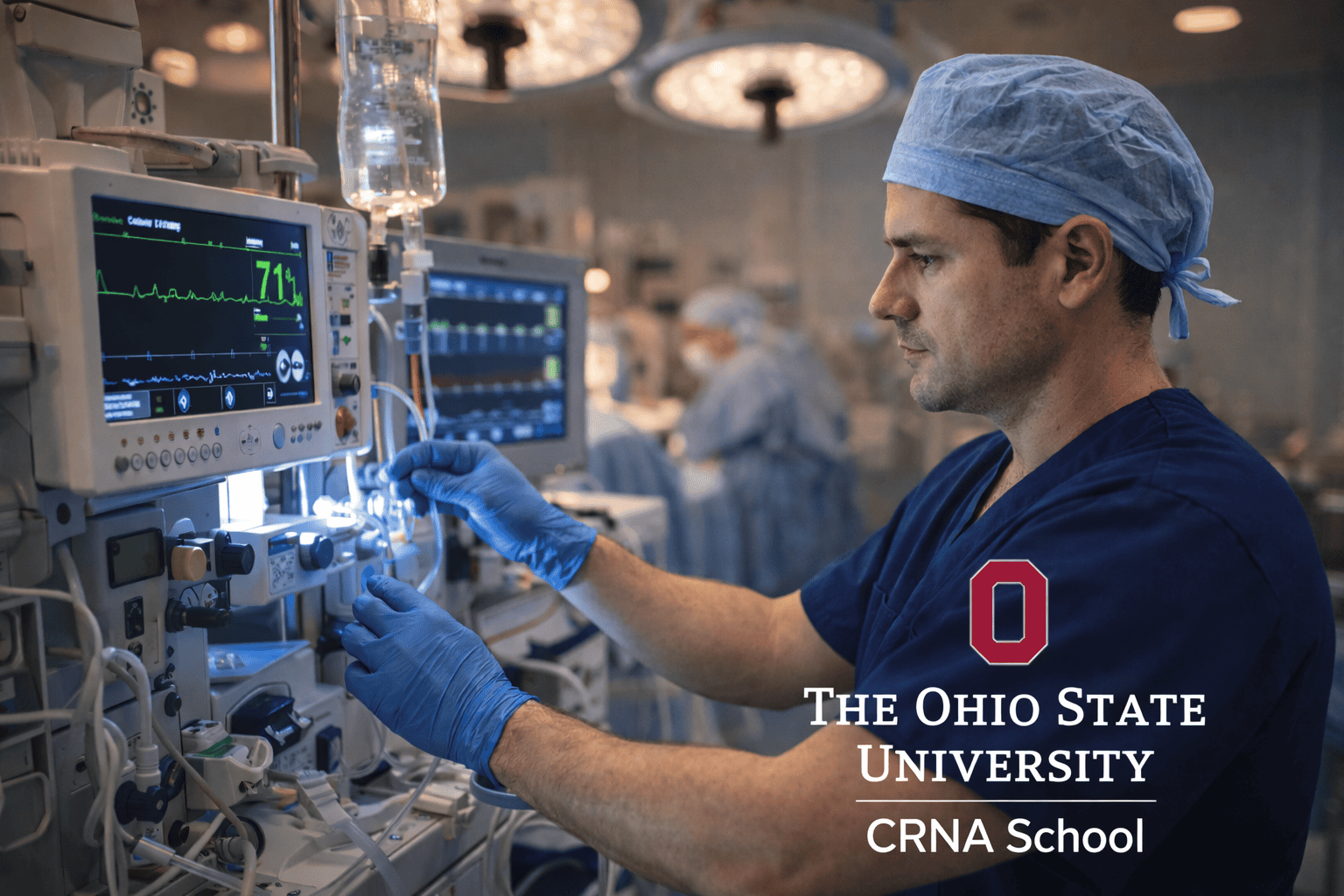
The Ohio State University College of Nursing offers a Nurse Anesthesia specialty track within its BSN-to-DNP program.
The program admitted its first cohort in Autumn 2024 and holds Initial Accreditation from the COA through May 2030.
This 2026 guide covers the current admission requirements, curriculum, accreditation status, faculty, tuition structure, and application timeline for the next available cohort.
Key Takeaways for the 2026 Applicant
- Degree: Doctor of Nursing Practice (BSN-to-DNP, Nurse Anesthesia specialty track), entry level.
- Length: 36 months full-time, including summers; 106 credit hours total.
- Start month: August (Autumn semester).
- Format: Online synchronous didactic with required in-person skills weeks (Year 1) and simulation days (Years 2–3).
- Clinical sites: All program-assigned, located across Ohio (primary regions: northwest Ohio and Central/Southern Ohio).
- COA accreditation: Initial Accreditation. DLR January 2024, NRD May 2030.
- GPA minimum: 3.0 cumulative on a 4.0 scale; B- or higher in statistics prerequisite.
- Critical care minimum: 1 year of recent (within 2 years) full-time RN experience in a qualifying critical care setting.
- ACLS/PALS: Not required to apply; required by the second semester.
- Next application cycle: Autumn 2027 cohort — application opens August 3, 2026.
Program Overview
Ohio State delivers nurse anesthesia education through a BSN-to-DNP entry-level pathway housed within the College of Nursing.
The program prepares Certified Registered Nurse Anesthetist (CRNA) candidates for the National Certification Examination administered by the NBCRNA.
John C. Welch, DNP, MS, APRN-CRNA serves as Program Director, with Nancy Moriber, PhD, CRNA, APRN, FAANA as Assistant Director.
The track operates within Ohio State’s broader BSN-to-DNP framework and uses a 36-month, full-time, year-round schedule that includes summer terms.
Format and Schedule
Didactic coursework is delivered online in a synchronous format, meaning students attend live sessions at scheduled times.
Year 1 includes intermittent in-person skills weeks on campus, and Years 2 and 3 include simulation days tied to clinical courses.
Clinical immersion begins in the third semester, with students typically in class one full day and in the operating room four full days per week.
Working during the program is not recommended; the COA requires at least 8 hours of rest between clinical responsibilities and outside employment.
Where the Program Lives
The College of Nursing is headquartered at Jane E. Heminger Hall, 1577 Neil Avenue, Columbus, OH 43210.
Clinical sites are distributed across Ohio, with primary regions in northwest Ohio and Central/Southern Ohio.
Students are expected to rotate across multiple sites to complete COA-required case experiences and may not propose their own clinical sites.
Accreditation Status
The Nurse Anesthesia specialty track at The Ohio State University College of Nursing holds Initial Accreditation from the Council on Accreditation of Nurse Anesthesia Educational Programs (COA).
Initial Accreditation is the standard status awarded to new programs as their first cohort progresses toward graduation.
- Date of Last Review (DLR): January 2024
- Next Review Date (NRD): May 2030
- Status: Initial Accreditation
You can verify Ohio State’s current status on the official COA List of Accredited Educational Programs (PDF, March 6, 2026).
Admission Requirements
Academic Prerequisites
- BSN from a regionally accredited institution; international degrees require evaluation by an approved agency for U.S. equivalency and 4.0-scale GPA conversion.
- Cumulative GPA of 3.0 or higher in the most recent relevant degree.
- Completed undergraduate statistics course with a grade of B- or higher.
- Holistic review — applicants with lower GPAs may still be considered when the broader profile is strong.
Licensure
An active, unencumbered RN license is required in the state where the applicant currently practices.
An Ohio RN license must be in hand by August 1 of the matriculation year, though it is not required at the time of application.
Critical Care Experience
Ohio State requires a minimum of one year of recent, full-time RN critical care experience, with “recent” defined as within two years of application.
The experience must occur within the United States, its territories, or a U.S. military hospital outside the United States.
A qualifying critical care area is one where the RN routinely manages invasive hemodynamic monitors, cardiac assist devices, mechanical ventilation, and vasoactive infusions.
Examples include surgical ICU, cardiothoracic ICU, coronary ICU, medical ICU, pediatric ICU, and neonatal ICU.
Other settings may be considered if the applicant demonstrates competence with unstable patients, invasive monitoring, ventilators, and critical care pharmacology.
Required Certifications
- ACLS and PALS are not required at application but must be completed by the second semester before clinical rotations begin.
- ACLS and PALS must be maintained for the duration of the program.
- Student malpractice insurance is required by the second semester.
GRE Policy
Ohio State’s BSN-to-DNP application does not list the GRE as a required component.
Always confirm the current testing policy on the official Nurse Anesthesia program page before submitting your application.
Application Materials
- Completed online graduate application via Ohio State Graduate and Professional Admissions.
- Three letters of recommendation from individuals who can speak to clinical and leadership abilities.
- Purpose and goals statement describing professional experience, career goals, and DNP program alignment.
- Video interview as part of the holistic review process.
- Resume documenting professional experience.
- Official transcripts from all undergraduate and graduate institutions attended.
Application Timeline
- Autumn 2026 cohort: application is currently closed.
- Autumn 2027 cohort: application opens August 3, 2026.
- Round 1 decisions: Early December.
- Round 2 decisions: Late April for second-round interview offers.
- Acceptance window: Round 1 — four weeks post-decision; Round 2 — two weeks post-decision.
Curriculum Snapshot
The 106-credit-hour curriculum is delivered across nine semesters spanning three calendar years.
Year 1 establishes the foundation in pathophysiology, evidence-based practice methods, advanced health assessment, advanced pharmacology, and the scientific foundations of nurse anesthesia.
The first-year course load is roughly 16 credit hours per fall and spring semester, plus 12 credit hours in summer.
Years 2 and 3 shift into clinical immersion with operating room rotations four full days per week, paired with simulation days and ongoing didactic coursework.
The DNP project is integrated throughout the doctoral coursework and completed prior to graduation.
Tuition and Fees
Ohio State’s College of Nursing assesses a differential fee structure for Nurse Anesthesia specialty track students on top of base BSN-to-DNP tuition.
Because the specialty is delivered online, current cost specifics are published through Ohio State Online rather than the standard Columbus campus rate sheet.
Always confirm current rates directly on Ohio State’s official College of Nursing Tuition and Fees page before budgeting.
The program does not offer stipends, and most financial aid for the specialty track comes through federal student loans.
Faculty and Leadership
- John C. Welch, DNP, MS, APRN-CRNA — Director, Nurse Anesthesia Track.
- Nancy Moriber, PhD, CRNA, APRN, FAANA — Assistant Director.
- Kathleen Piotrowski — Faculty.
- Tina Dalzell — Faculty.
- Nate Sellers — Faculty.
Outcomes and Career Path
The first cohort entered the program in Autumn 2024 and is on track for a 2027 graduation, so first-time NCE pass-rate data is not yet published.
Graduates are eligible to sit for the National Certification Examination through the NBCRNA.
Successful exam passage allows graduates to use the Certified Registered Nurse Anesthetist (CRNA) credential and pursue AANA membership.
How Ohio State Compares with Other Ohio CRNA Programs
Ohio currently has eight COA-accredited entry-level nurse anesthesia programs.
Ohio State is the newest of those programs and the only one anchored in a top-25 nationally ranked nursing college within a Big Ten academic medical center.
Compared to Akron, Cincinnati, Otterbein, Lourdes, Cleveland Clinic, Ohio University, Ursuline, and Youngstown State, Ohio State is distinguished by its statewide rural-rotation philosophy and its tight integration with the Wexner Medical Center.
Who This Program Is Best For
- BSN-prepared RNs with strong, recent (within two years) ICU experience and demonstrable academic readiness.
- Applicants comfortable with synchronous online didactic plus periodic in-person travel to Columbus for skills weeks and simulation.
- Candidates open to clinical rotations across multiple Ohio sites rather than at a single home hospital.
- Aspiring CRNAs interested in being part of an early cohort at a research-intensive academic medical center.
Frequently Asked Questions
Is the Ohio State CRNA program accredited?
Yes — the Nurse Anesthesia specialty track holds Initial Accreditation from the COA, with DLR January 2024 and NRD May 2030.
What degree does Ohio State’s CRNA program award?
Graduates earn a Doctor of Nursing Practice (DNP) with the Nurse Anesthesia specialty designation, completed through the BSN-to-DNP entry-level pathway.
How long is the Ohio State CRNA program?
The program is 36 months of full-time study, including summers, totaling 106 credit hours.
When does the program start?
Cohorts begin each Autumn semester (August), with the first cohort having started in Autumn 2024.
When can I apply for the next cohort?
The Autumn 2026 application window is closed, and the Autumn 2027 application opens August 3, 2026.
Does Ohio State require ACLS or PALS at application?
No — neither is required at the application stage, but both must be completed by the second semester before clinical rotations.
What kind of ICU experience does Ohio State accept?
One year of recent, full-time RN experience in a critical care area where the nurse routinely manages invasive hemodynamic monitors, cardiac assist devices, mechanical ventilation, and vasoactive infusions.
Can I work during the program?
Working is not recommended; the program is full-time only, and COA-mandated rest periods limit outside clinical work.
Do I have to relocate to Columbus?
The didactic portion is online, but in-person skills weeks, simulation days, and clinical rotations across Ohio require travel and may require relocation depending on assigned sites.
Where can I learn more?
Visit the official program page at Ohio State College of Nursing — Nurse Anesthesia or contact welch.174@osu.edu for program-specific questions.