The University of Akron’s Post-BSN-DNP Nurse Anesthesia Program is a 36-month, full-time entry-level doctorate that admits its next cohort in June 2026.
Akron holds a perfect 10-year COA accreditation through May 2034 and uses a synchronous online didactic format paired with in-person simulation and a 33-month clinical residency.
This 2026 guide covers admission requirements, tuition, accreditation, curriculum, and what makes Akron different from other Ohio nurse anesthesia programs.
Key Takeaways for the 2026 Applicant
- Degree: Doctor of Nursing Practice — Nurse Anesthesia (Post-BSN-DNP), entry level.
- Length: 36 months, full time, 93 credit hours.
- Start month: June (next cohort begins June 2026).
- Format: Synchronous online didactic with in-person simulation and lab; 33-month clinical residency.
- COA accreditation: Full Accreditation, perfect 10-year cycle. DLR May 2024, NRD May 2034.
- GPA minimum: 3.0 on 4.0 scale for all nursing and science coursework.
- Critical care minimum: 1 year of current, consecutive adult critical care experience.
- Required certifications: CCRN (with score report) and current ACLS.
- GRE: Not required.
- Application deadline: August 1 each year for the following June cohort.
Program Overview
The University of Akron offers an entry-level Doctor of Nursing Practice in Nurse Anesthesia.
The program is delivered through The University of Akron’s School of Nursing within the College of Health and Human Sciences.
Sean Moore, PhD, DNP, CRNA serves as Program Director, with Kaitlin Vazquez, PhD, DNP, CRNA as Assistant Director.
The curriculum totals 93 credit hours: 14 core graduate credits, 37 DNP nursing credits, and 42 anesthesia-specific credits.
Coursework spans advanced physiology and pathophysiology, chemistry, physics, basic and advanced pharmacology, and principles of anesthesiology.
Format and Schedule
Akron uses a synchronous online didactic format, meaning students attend live classes online at scheduled times rather than working asynchronously at their own pace.
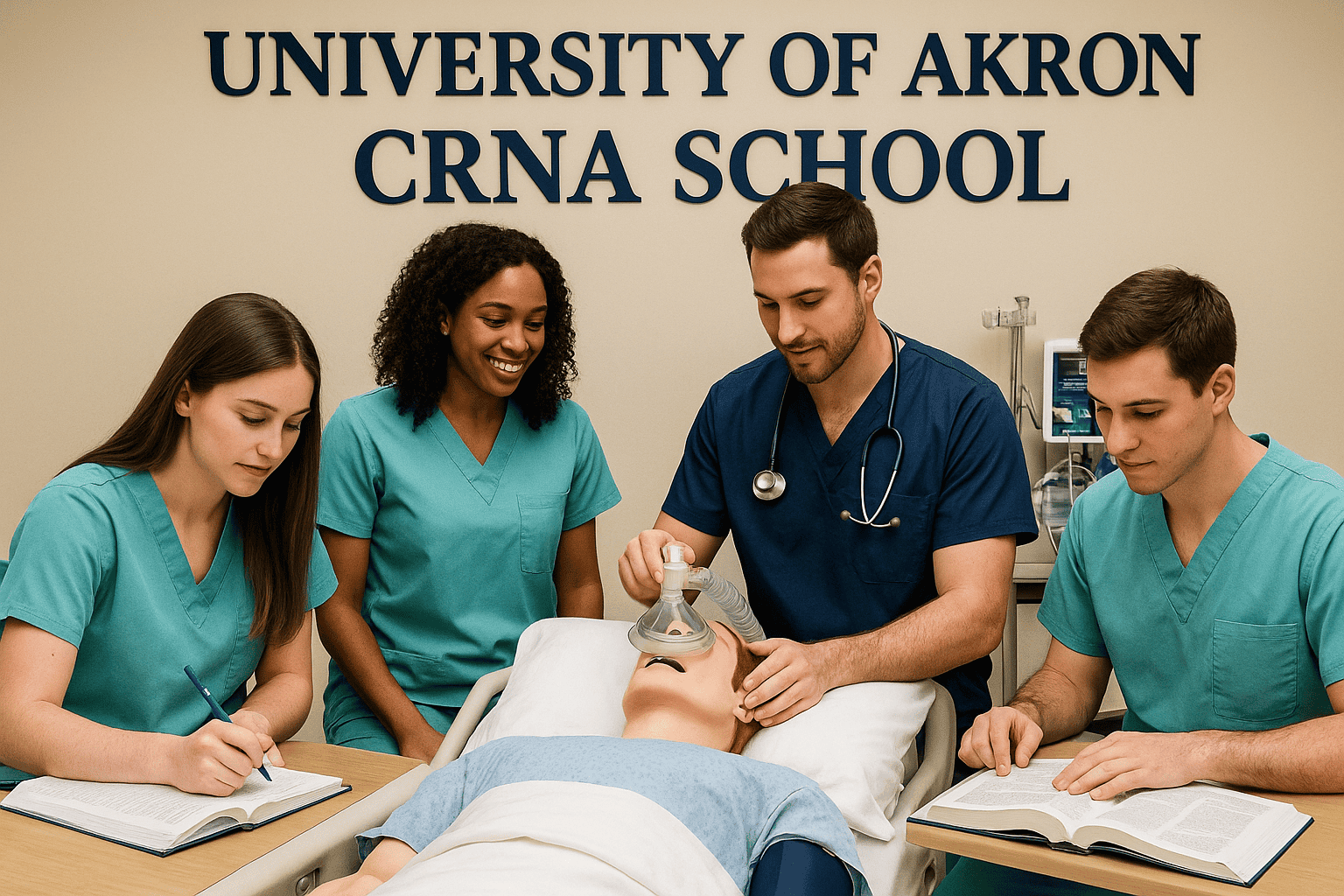
In-person simulation, lab work, and clinical residency are required components of the program.
The first year is largely didactic with about 16 clinical hours per week.
The 33-month clinical residency component delivers the supervised hours required for COA standards and graduation.
Where the Program Lives
The Nurse Anesthesia Program is administratively located at 209 Carroll Street, Akron, OH 44325-3701.
Akron is a mid-size Ohio city in the Cleveland-Akron-Canton region with a lower cost of living than most major metro markets.
Accreditation Status
The University of Akron’s Post-BSN-DNP Nurse Anesthesia Program holds Full Accreditation from the Council on Accreditation of Nurse Anesthesia Educational Programs (COA).
The program received a perfect 10-year accreditation cycle, the longest cycle COA awards.
- Date of Last Review (DLR): May 2024
- Next Review Date (NRD): May 2034
- Status: Full Accreditation
You can verify Akron’s current status on the official COA List of Accredited Educational Programs (PDF, March 6, 2026).
Admission Requirements
Academic Prerequisites
- BSN from a CCNE- or NLN-accredited baccalaureate nursing program.
- Minimum 3.0 GPA on a 4.0 scale across all nursing degrees and science coursework.
- Minimum prerequisite coursework: 3 hours of chemistry, 6 hours of anatomy & physiology, and 3 hours of microbiology.
- Classes that have been retaken are not averaged into your overall GPA calculation.
Licensure
Applicants must hold a current unencumbered RN Ohio Board of Nursing license at the start of the program.
Any prior revocation, denial, suspension, or restriction of an RN license from any U.S. state or country disqualifies the applicant.
Critical Care Experience
Akron requires a minimum of one year of current, consecutive adult critical care nursing experience before the admission interview.
The following clinical settings do not qualify as critical care experience for Akron’s program: operating room, labor and delivery, step-down telemetry, neonatal intensive care, emergency room, post-anesthesia care units, and cardiac catheterization labs.
Pediatric intensive care experience is evaluated on an individual basis.
Required Certifications
- CCRN certification with official score report submitted in the application.
- Current ACLS certification, maintained throughout the entire program.
- 16 hours of documented CRNA shadowing using Akron’s required Observation Form.
GRE Policy
The University of Akron does not require the GRE for Nurse Anesthesia Program applicants.
Application Materials
- Completed online Graduate School application.
- Official transcripts from every college or university attended.
- Three references attesting to clinical and academic skills and potential.
- A 300-word position paper describing professional goals, purpose in seeking graduate education, and why The University of Akron specifically.
- Resume in Akron’s required template format (alternate formats are not accepted).
- CCRN score report.
- Completed CRNA Observation Form.
Application Timeline
- Application deadline: August 1 of the year prior to the desired June start.
- Selection committee interviews: September and October.
- Cohort start: June of the following year.
- Class of 2030 cycle: applications accepted until August 1, 2026, with interviews in September–October 2026.
Curriculum Snapshot
The 93-credit curriculum is structured across three main blocks.
- 14 credits — core graduate nursing courses.
- 37 credits — DNP-level graduate nursing courses, including the DNP project.
- 42 credits — graduate anesthesia coursework, including basic and advanced pharmacology, advanced physiology and pathophysiology, chemistry, physics, and principles of anesthesiology.
Clinical experience covers neuraxial blockade, peripheral nerve blockade, general anesthesia, intravenous anesthesia, and monitored anesthetic care under CRNA and physician supervision.
Tuition and Fees (2025–26)
The Nurse Anesthesia Program charges a special program rate that differs from standard graduate tuition at The University of Akron.
- Anesthesia courses (42 credits): $900 per credit hour for Ohio residents.
- Non-anesthesia DNP and core courses (51 credits): $482.75 per credit hour for Ohio residents.
- Non-resident surcharge: $320 per credit hour for traditional in-person programs.
- Online-only programs: non-resident surcharge drops to $1 per credit hour.
Because Akron’s didactic curriculum is delivered synchronously online, the non-resident surcharge structure can make the program meaningfully more affordable for out-of-state applicants compared to traditional brick-and-mortar programs.
Always confirm current rates directly with University of Akron Student Accounts before budgeting.
Faculty and Leadership
- Sean Moore, PhD, DNP, CRNA — Director, Nurse Anesthesia Program.
- Kaitlin Vazquez, PhD, DNP, CRNA — Assistant Director, Nurse Anesthesia Program; Assistant Director of Graduate Programs.
- Ashley Jasinsky, DNAP, MSN, CRNA — Assistant Professor of Instruction.
- Howie Brown, DNP, CRNA — Assistant Professor of Instruction.
Outcomes
Akron’s School of Nursing reported a 100% overall pass rate and 0% attrition for the Class of 2025.
Graduates are eligible to sit for the National Certification Examination administered by the NBCRNA.
Successful exam passage allows graduates to use the Certified Registered Nurse Anesthetist (CRNA) credential and pursue AANA membership.
Early Assurance Pathway
Akron offers a four-phase Early Assurance Pathway for high school graduates planning a nurse anesthesia career.
The selection committee may accept up to 12 high school graduates annually into this pathway.
The pathway covers BSN completion at Akron, ICU work as a new graduate nurse, and reserved consideration for the Post-BSN-DNP Nurse Anesthesia Program within five years of BSN graduation.
How Akron Compares with Other Ohio CRNA Programs
Ohio currently has eight COA-accredited entry-level nurse anesthesia programs.
Akron is the longest-running and largest of the Ohio programs, with cohorts of up to 45 students annually and a synchronous online format that draws applicants from across the country.
Compared to Cincinnati, Otterbein, Lourdes, Cleveland Clinic, Ohio University, Ursuline, and Youngstown State, Akron is distinguished by its perfect 10-year accreditation cycle and the early-assurance pipeline at the undergraduate level.
Who This Program Is Best For
- BSN-prepared RNs with at least one year of solid adult ICU experience and a CCRN in hand.
- Applicants who prefer synchronous online didactic learning over traditional face-to-face lecture.
- Out-of-state applicants who want to keep tuition manageable thanks to the $1 online-only non-resident surcharge.
- Candidates who can commit to 36 months of full-time study without outside employment.
Frequently Asked Questions
Is the University of Akron CRNA program accredited?
Yes — the program holds Full Accreditation from the COA with a perfect 10-year cycle, DLR May 2024 and NRD May 2034.
What degree does Akron’s CRNA program award?
Graduates earn a Doctor of Nursing Practice (DNP) with a Nurse Anesthesia track.
How long is the Akron CRNA program?
The program is 36 months of full-time study totaling 93 credit hours, with cohorts starting each June.
Does Akron require the GRE?
No — the GRE is not required for the Nurse Anesthesia Program at The University of Akron.
What kind of ICU experience does Akron require?
Akron requires a minimum of one year of current, consecutive adult critical care experience before the interview.
OR, L&D, step-down telemetry, NICU, ER, PACU, and cath lab experience are not accepted as critical care for this program.
Is the CCRN required at Akron?
Yes — current CCRN certification with an official score report is required as part of the application.
When are applications due?
All application materials must be submitted by August 1 of the year prior to the desired June cohort start.
How is Akron’s curriculum delivered?
The didactic portion is delivered synchronously online, while simulation, lab, and the 33-month clinical residency are completed in person.
Where can I learn more about Akron’s program?
Visit the official program page at University of Akron School of Nursing or contact Susan Bradford, Student Services Counselor, at sb14@uakron.edu.