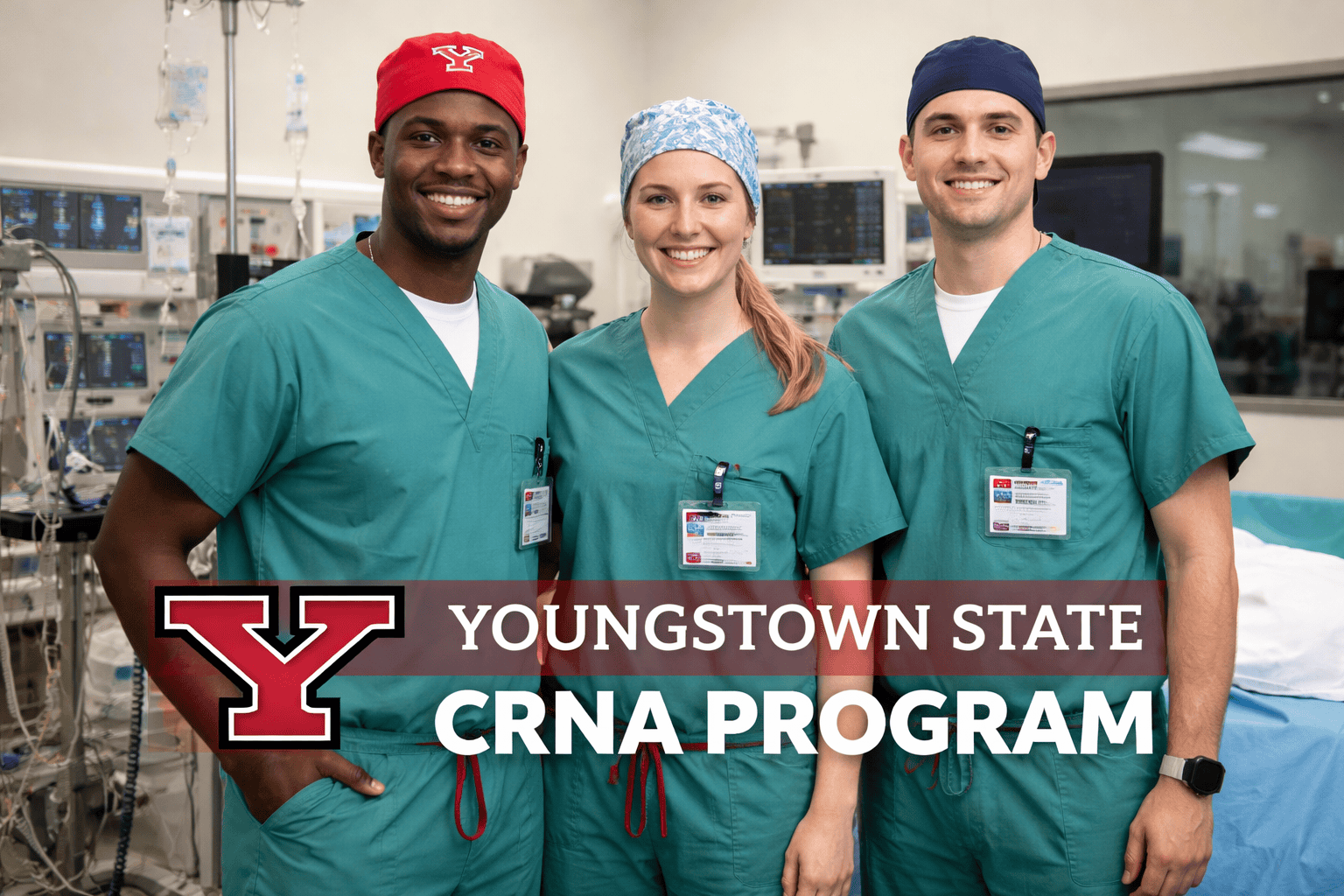
The Doctor of Nursing Practice in Nurse Anesthesia at Youngstown State University is a 36-month cooperative program delivered with the St. Elizabeth Health Center School for Nurse Anesthetists, Inc. (SEHC).
The program holds Full Accreditation from the COA through May 2027 and admits one cohort each May.
This 2026 guide covers the cooperative model, admission requirements, accreditation, curriculum, and what makes this Mahoning Valley CRNA program unique.
Key Takeaways for the 2026 Applicant
- Degree: Doctor of Nursing Practice — Nurse Anesthesia, entry level (cooperative YSU + SEHC).
- Length: 36 months, full time.
- Start month: May.
- Format: Didactic at Youngstown State University; clinical and anesthesia training at St. Elizabeth-affiliated sites.
- COA accreditation: Full Accreditation. DLR May 2017, NRD May 2027.
- GPA minimum: 3.0 cumulative undergraduate nursing GPA and 3.0 in undergraduate science coursework.
- Critical care minimum: Adult critical care RN experience with interpretation of invasive monitors.
- Required certifications: CCRN, BLS, ACLS.
- GRE policy: Required only if cumulative GPA is below 3.5 (GRE code 3479).
- Application window: May 1 to July 31 annually for the following May cohort.
Program Overview
The program is a cooperative DNP delivered jointly by Youngstown State University’s Bitonte College of Health and Human Services and the St. Elizabeth Health Center School for Nurse Anesthetists, Inc.
Acceptance into the YSU DNP program is contingent on acceptance into SEHC.
All courses are taught by YSU Graduate Faculty and faculty from the anesthesia school.
Clinical anesthesia experience is supervised by Certified Registered Nurse Anesthetists and Staff Anesthesiologists from Bel-Park Anesthesia Associates, Inc.
Bon Secours-Mercy Health Partners supports the program by providing clinical resources across multiple Mahoning Valley sites.
Cooperative Model
The DNP degree is awarded by Youngstown State University, while the nurse anesthesia clinical program is administered by SEHC.
Applicants apply through SEHC; YSU graduate admission follows once an offer is made by the anesthesia school.
The cooperative format means academic coursework, faculty, and clinical training are integrated across the two institutions.
Where the Program Lives
Didactic coursework is based at Cushwa Hall on the YSU campus, 1 Tressel Way, Youngstown, OH 44555.
SEHC’s mailing address is PO Box 1790, 1044 Belmont Avenue, Youngstown, OH 44501-1790.
Youngstown sits in the Mahoning Valley between Cleveland and Pittsburgh, with a notably low cost of living for the Northeast Ohio region.
Clinical Sites
- St. Elizabeth Youngstown Hospital.
- St. Elizabeth Boardman Hospital.
- St. Joseph Warren Hospital.
- The Surgery Center Howland.
- Akron Children’s of the Mahoning Valley.
Accreditation Status
The program holds Full Accreditation from the Council on Accreditation of Nurse Anesthesia Educational Programs (COA).
- Date of Last Review (DLR): May 2017
- Next Review Date (NRD): May 2027
- Status: Full Accreditation
You can verify current status on the official COA List of Accredited Educational Programs (PDF, March 6, 2026).
Admission Requirements
Academic Prerequisites
- BSN from an accredited baccalaureate nursing program.
- Minimum 3.0 cumulative GPA calculated from all undergraduate nursing coursework.
- Minimum 3.0 GPA in all undergraduate science coursework.
Licensure
Verification of current, unencumbered RN licensure is required at application.
An Ohio RN license must be in place by program start; out-of-state applicants typically obtain Ohio licensure prior to matriculation.
Critical Care Experience
The program educates experienced Registered Nurses with a strong clinical background in critical care.
Adult critical care experience is preferred because it provides experience in the interpretation of invasive monitors, ventilator management, and titration of vasoactive medications.
Critical care experience must be obtained within the United States or its territories.
Required Certifications
- CCRN certification (current).
- Current Basic Life Support (BLS).
- Current Advanced Cardiac Life Support (ACLS).
GRE Policy
The GRE is required only for applicants with a cumulative GPA below 3.5.
Applicants who must submit the GRE should have scores sent directly to SEHC using GRE code 3479.
Application Materials
- Completed SEHC application packet with $50 application fee.
- Verification of unencumbered RN license.
- Copies of current ACLS and BLS certifications.
- CCRN certification copy.
- Official transcripts from all prior post-secondary institutions.
- Personal goals statement describing how past experiences shaped career goals.
- Personal interview as part of the admissions decision.
Application Timeline
- Application opens: May 1 each year for the following May cohort.
- Application deadline: July 31 of the year prior to matriculation.
- Personal interviews: conducted after the application window closes.
- 2026 cohort: applications are currently closed.
- 2027 cohort: watch the official SEHC site for the next opening on May 1, 2026.
Curriculum Snapshot
The DNP curriculum integrates core graduate nursing coursework with nurse anesthesia didactic and clinical sequences.
Year 1 establishes graduate-level foundations alongside introductory anesthesia coursework.
Years 2 and 3 transition into intensive clinical practicum rotations across the program’s affiliated hospitals and surgery centers.
The DNP project is integrated throughout the doctoral coursework and completed prior to graduation.
Tuition and Fees
Because this is a cooperative DNP, students pay tuition through Youngstown State University while paying program-specific fees to SEHC.
YSU’s graduate tuition is among the most affordable in Ohio for both in-state and out-of-state applicants.
Always confirm the current tuition rate on the official YSU Graduate School website before budgeting.
Faculty and Leadership
- John M. Underwood, DNAP, APRN-CRNA — Program Director, SEHC.
- Douglas Shaffer, DNAP, CRNA, APRN — Assistant Program Director, SEHC.
- Steven Sheakoski, MD — Medical Director.
Outcomes and Career Path
Graduates are eligible to sit for the National Certification Examination administered by the National Board on Certification and Recertification of Nurse Anesthetists.
Successful exam passage allows graduates to use the Certified Registered Nurse Anesthetist (CRNA) credential.
CRNAs in Ohio also apply for licensure as an Advanced Practice Registered Nurse with the Ohio Board of Nursing.
Graduates can pursue AANA membership and state-level participation through the Ohio Association of Nurse Anesthetists.
How YSU/SEHC Compares with Other Ohio CRNA Programs
Ohio currently has eight COA-accredited entry-level nurse anesthesia programs.
The YSU/SEHC cooperative is the only Ohio program structured as a formal partnership between a public university and a free-standing hospital-based school.
Compared to Akron, Cincinnati, Otterbein, Lourdes, Cleveland Clinic, Ohio University, Ursuline, and Ohio State, this cooperative is distinguished by its concentrated Mahoning Valley clinical footprint and its small annual cohort size.
Who This Program Is Best For
- BSN-prepared RNs with strong adult ICU experience and a CCRN credential.
- Applicants comfortable relocating to or commuting within the Mahoning Valley.
- Candidates seeking an affordable cooperative DNP at a public university.
- Applicants with cumulative GPAs at or above 3.5 (or below with strong GRE scores).
Frequently Asked Questions
Is the YSU/SEHC CRNA program accredited?
Yes — the program holds Full Accreditation from the COA with a DLR of May 2017 and NRD of May 2027.
Who awards the degree?
Youngstown State University awards the Doctor of Nursing Practice degree, while St. Elizabeth Health Center School for Nurse Anesthetists administers the nurse anesthesia clinical program.
How long is the program?
The program is 36 months of full-time study with cohorts starting each May.
Does the program require the GRE?
The GRE is required only for applicants with a cumulative GPA below 3.5.
What kind of ICU experience is preferred?
Adult critical care experience that includes interpretation of invasive monitors, mechanical ventilation, and vasoactive medication titration.
Is CCRN required?
Yes — CCRN certification is required as part of the application.
When is the application window?
SEHC accepts applications from May 1 to July 31 each year for the following May cohort.
How do I apply?
Applicants apply directly through SEHC; YSU graduate admission is processed after a SEHC offer is made.
Where can I learn more?
Contact Program Director John M. Underwood at underwood@belpark.net or 330-480-3444 for program-specific questions.