
Are you thinking of enrolling in an accredited nurse anesthesia educational program? Then you might be wondering how long it will take to complete CRNA school.
Every accredited CRNA program today is a doctorate (DNP or DNAP) — the master’s route no longer exists for new students. Programs run 36 to 51 months of full-time study, and most take 36 months. Counting a 4-year BSN and 1–3 years of ICU experience, plan on roughly 8–10 years from freshman year to CRNA.
Last updated: July 2026 · Program counts and lengths verified against the COA accredited-programs list (March 6, 2026) and AANA’s Become-a-CRNA page.
| Step | Typical Time |
|---|---|
| BSN degree | 4 years |
| NCLEX-RN licensure | A few weeks after graduation |
| Critical care (ICU) experience | 1–3 years |
| Doctoral nurse anesthesia program (DNP or DNAP) | 3–4.25 years |
| NCE + state licensure | A few weeks |
| Total | About 8–10 years |
Pursuing a CRNA career may take some time, but it’s worth it. If you’re planning on making this your career specialty, then make sure to read the helpful details below.
How Long is a CRNA Program?
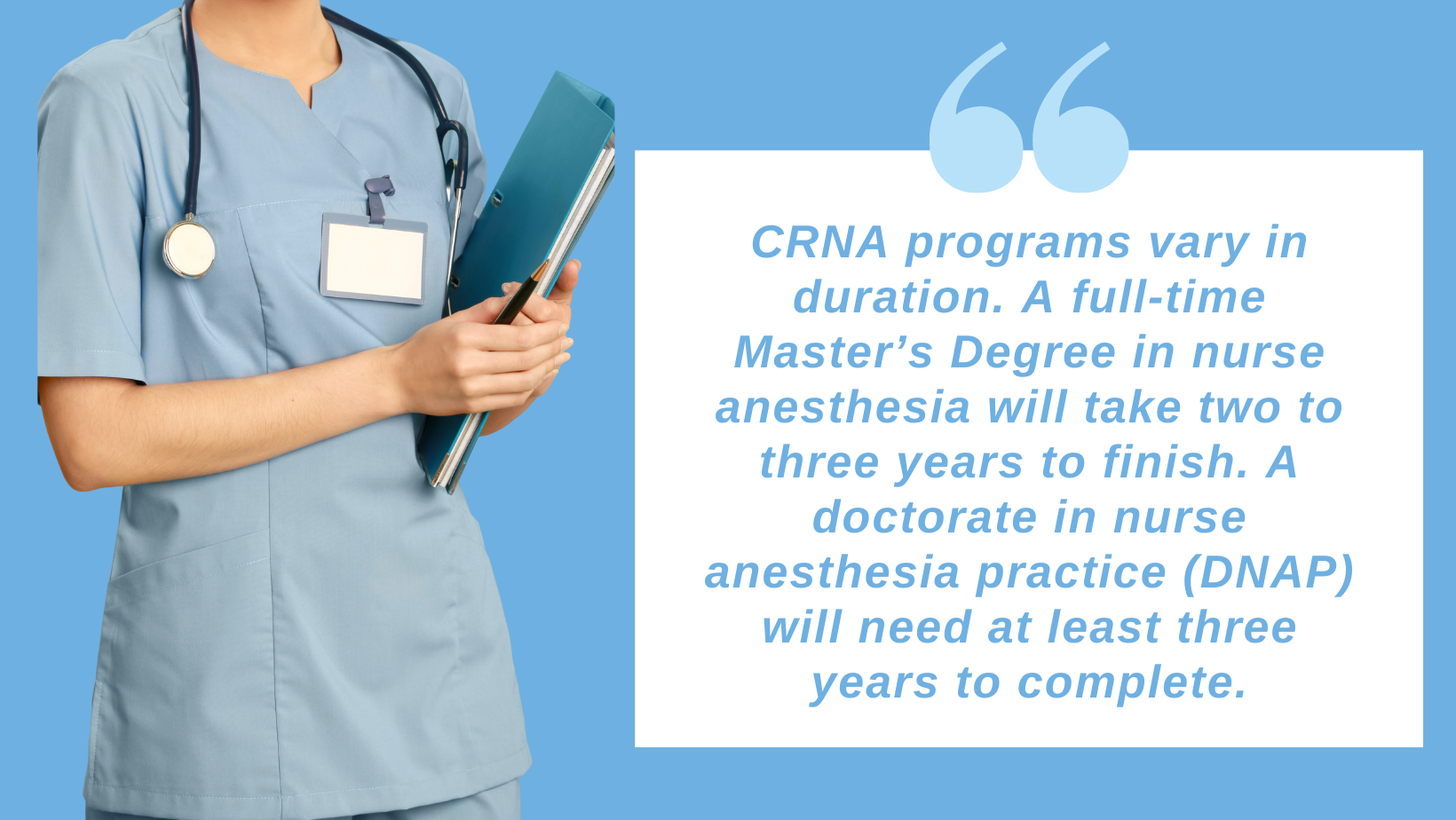
Accredited nurse anesthesia programs take 36 to 51 months to complete — three years for most. Every program is a full-time doctorate (DNP or DNAP).
How long yours takes depends mostly on the university — the COA lists program lengths from 36 to 51 months. What doesn’t vary: it’s a doctorate, and it’s full time.
BSN to DNP or DNAP: 36–51 Months (the Only Path Today)
Since January 1, 2022, the Council on Accreditation (COA) has required every new nurse anesthesia student to enroll in a doctoral program — a DNP or DNAP. Master’s entry programs have fully phased out.
Most programs run 36 months of continuous, full-time study; some stretch to 51 months depending on the university. There’s no part-time option — plan for three intense years.
Already a Master’s-Prepared CRNA? Completion DNP: One to Two Years
Practicing CRNAs who trained in the master’s era can upgrade with a completion DNP or DNAP. This is a degree top-up for working CRNAs — not a way to become one.
Full time, a completion doctorate takes one to two years, and many run online so you can keep working while you study.
How Can I Become a CRNA Fast?
Unfortunately, there is no shortcut to becoming a CRNA. Students should follow these steps to get into an accredited nurse anesthesia program:
1. Obtain a BSN Degree
A BSN is one of the main requirements for nurse anesthesia educational programs. If you are a licensed RN with an associate’s degree, you will need to take an RN to BSN degree.
If you already have a non-nursing bachelor’s degree, you can take an accelerated BSN program.
2. Get an RN License
If you took the RN to BSN program, you may skip this step.
BSN and accelerated program graduates, however, need to take the NCLEX-RN to get a license. It is a computerized exam that will gauge the knowledge you’ve earned from nursing school.
Remember: you can’t become a CRNA if you are not a licensed RN.
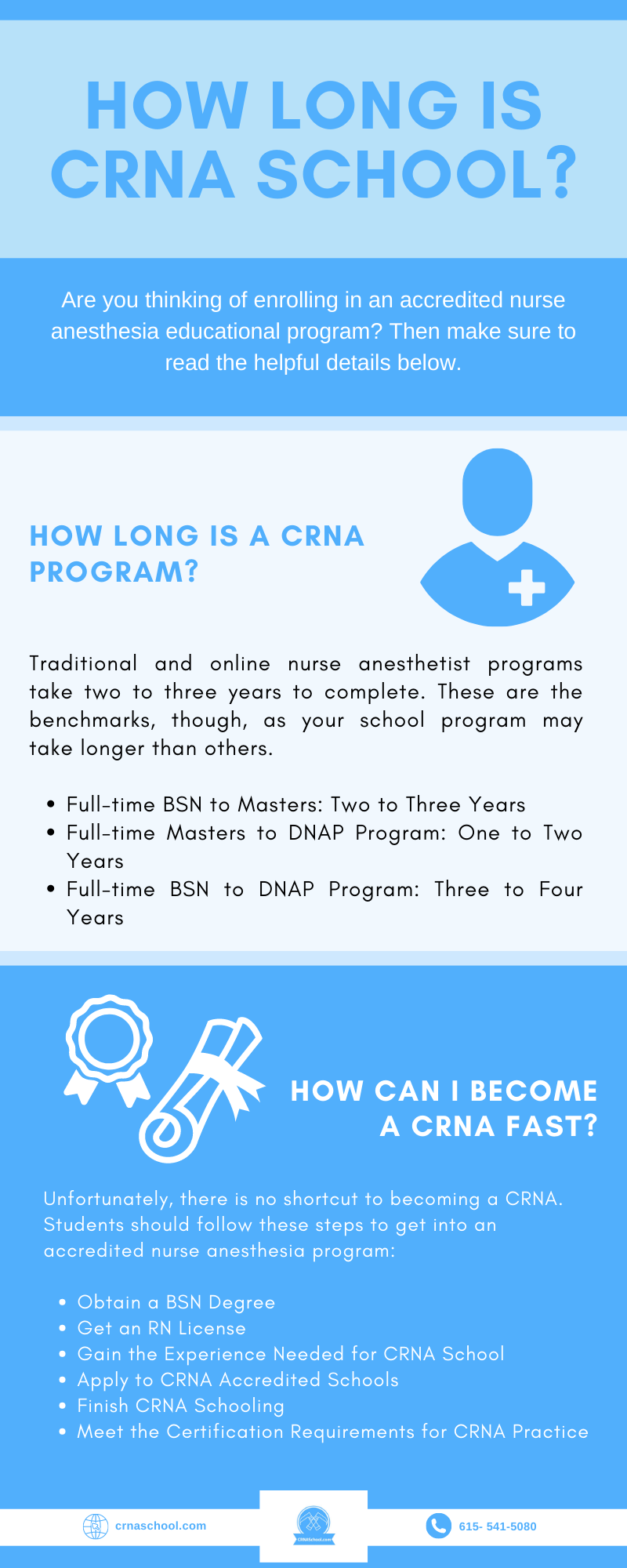
3. Gain the Experience Needed for CRNA School
Budding CRNAs need critical care experience to handle the complexities of nurse anesthesia practice. The COA minimum is one year of full-time critical care, but competitive applicants typically bring two to three years — and some programs require two outright.
Which ICU Experience is Best for CRNA?
Budding CRNAs should go for ICU or coronary care unit experience. Since not all ICU experiences are equal, it’s best to work in a unit where you’ll get experience in:
- Hemodynamic monitoring
- Invasive lines
- Vasoactive infusions
- Ventilator support
- Continuous electrocardiogram monitoring

4. Apply to CRNA Accredited Schools
In the US, you can apply to any of the 155 COA-accredited nurse anesthesia programs (March 2026 list) — every one of them awards a doctorate. Not sure about timing? See our guide on when to apply to CRNA school.
What GPA Do CRNA Schools Look at?
Requirements vary according to school, though most set a minimum GPA of 3.0. Given the competitive nature of such programs, you have better chances if you have a GPA of at least 3.5.
How Do I Get Into CRNA With a Low GPA?
Even if you don’t meet the threshold, you can still make your CRNA dreams come true. All you need to do is follow these tips for getting into nurse anesthesia school:
- Tell your story
You may have valid reasons why your GPA doesn’t meet the school’s requirements. It will help to talk about the trials and tribulations you’ve faced en route to becoming an RN. This will show the school that you’re determined and resilient – qualities a CRNA should possess.
- Take graduate-level courses
This is recommended if you finished your BSN more than five years ago. This will show that even if you have a low GPA, you’re trying to improve yourself.
- Get the best experience possible
Schools will accept experience in any adult ICU setting. However, it pays to get the most comprehensive experience possible.
If you work in a small-town ICU, it will help to transfer to a bigger hospital with more challenging cases.
- Work towards a good GRE grade
Not all CRNA schools require a GRE, but some do. If you want to enter an institution that requires this, then you have to study well. You need to have a score of 300 or better to boost your chances of getting into a CRNA program.

5. Finish CRNA Schooling
CRNA school helps prepare you for the challenging life ahead. To do so, you will need to finish several courses and clinical rotations.
During the first year, you will need to study basic science subjects. You will have to complete pharmacology and anesthesiology courses as well.
By the second year, you will be able to hone your skills through CRNA residency.
As a student registered nurse anesthetist, you’ll get hands-on practice. Duties include preparing the OR and administering anesthesia (under a CRNA.) By graduation, nurse anesthesia students average 9,432 hours of clinical experience (AANA, 2025) — which is exactly why these years feel so demanding.
6. Meet the Certification Requirements for CRNA Practice
After you finish CRNA school, you can take the National Certification Exam. It is designed to test the knowledge and abilities expected of entry-level CRNAs.
After taking the test, you may get a preliminary result at the test center. However, you will need the official test results to apply. You should receive this notification two to four weeks after your test.
Conclusion
The length of CRNA school depends on the program and the units you take.
A BSN-to-doctorate program takes 36 to 51 months of full-time study — most finish in three years. From starting your BSN to passing the NCE, the full journey usually runs 8 to 10 years.
Already a master’s-prepared CRNA? A completion doctorate adds one to two more years.
Whatever program you opt to take, the requirements for schooling remain the same. You need to have a BSN degree, an RN license, and relevant ICU experience to get into a CRNA school.

Daniel Etheridge, CRNA, has provided anesthesia for over 12 years across hospitals, surgery centers, and outpatient clinics in multiple U.S. states. He earned his BSN at Cumberland University and completed his nurse anesthesia training at Middle Tennessee School of Anesthesia (MTSA), graduating in 2013. He founded CRNAschool.com to give aspiring nurse anesthetists the honest, firsthand guidance he wished he had as a BSN-prepared ICU nurse applying to CRNA school. Read his full bio at https://crnaschool.com/about-the-author/.