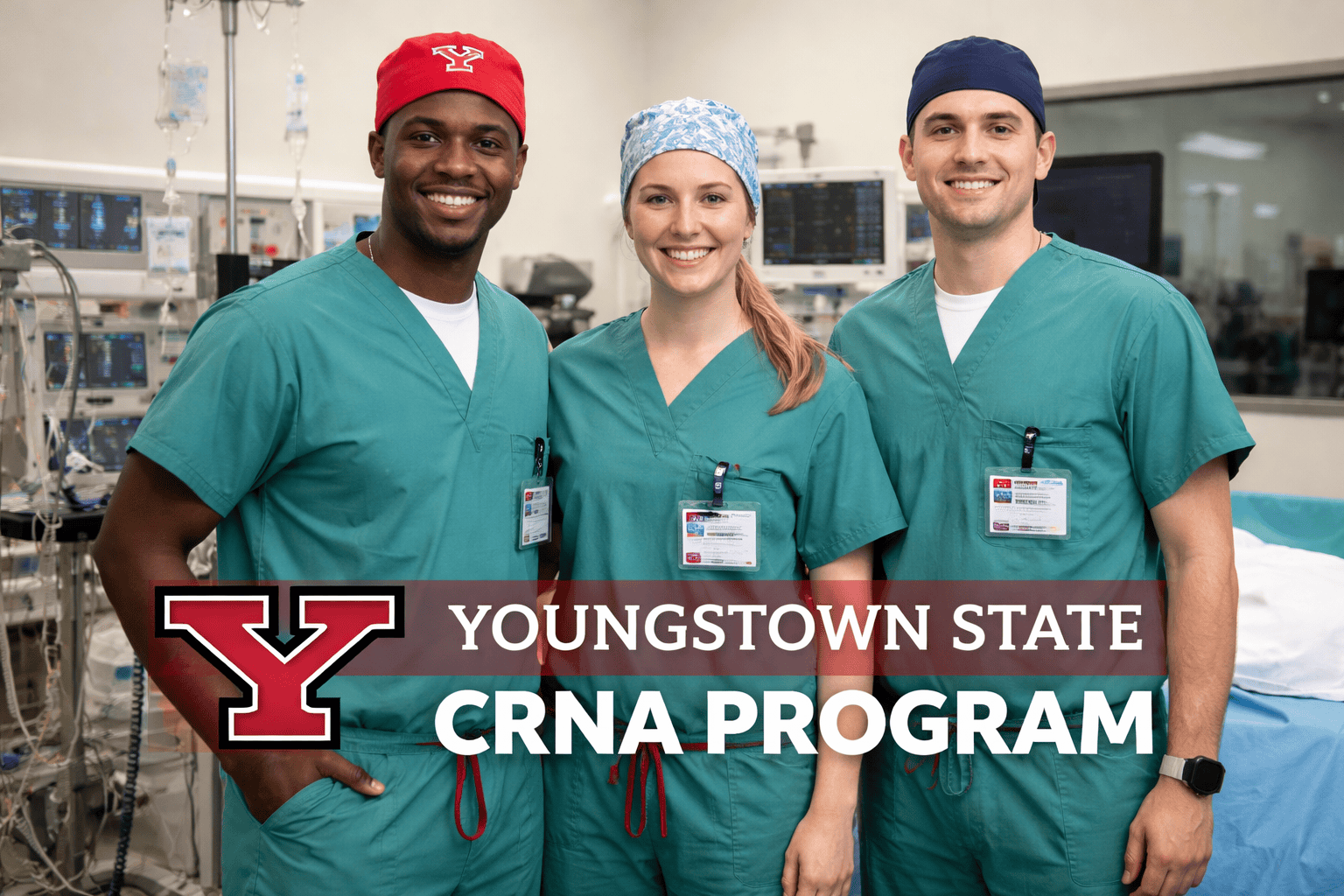
Youngstown State University CRNA School: Complete Partnership Program Guide (2025)
Last Updated: January 2026
Imagine landing your dream CRNA role straight out of school.
That’s exactly what happened to every single graduate from St. Elizabeth Health Center School for Nurse Anesthetists’ Class of 2025—100% employment within six months, paired with a perfect 100% first-time NCE pass rate.
Since 1947, this partnership between St. Elizabeth and Youngstown State University has been quietly building a reputation for excellence in nurse anesthesia education.
This isn’t your typical university CRNA program.
The cooperative structure between St. Elizabeth Health Center School for Nurse Anesthetists, Inc. and Youngstown State University offers something unique: hospital-based clinical immersion from day one, combined with the academic rigor and resources of a full university.
While you’ll earn your DNP from YSU, you’ll train alongside experienced CRNAs in real operating rooms, not just simulation labs.
This is one of 10 CRNA Schools in Ohio. Learn more about this school and how you can get on the path to becoming a highly trained CRNA.
CRNA School Information at a Glance
| Field | Details |
|---|---|
| Official School Name | St. Elizabeth Health Center School for Nurse Anesthetists, Inc. |
| University Partner | Youngstown State University |
| Program Length | 36 months, full-time |
| Application Deadline | July 31st annually (for May start the following year) |
| Degree Offered | Doctor of Nursing Practice (DNP) in Nurse Anesthesia |
| Tuition & Costs | Contact school at (330) 941-4200 for current rates |
| Recent Outcomes | 100% first-time NCE pass rate (Class of 2025) |
| 0% attrition rate (Class of 2025) | |
| 100% employment within 6 months (Class of 2025) | |
| Program Director | John M. Underwood, DNAP, APRN-CRNA |
| Phone | (330) 941-4200 |
| schoolinfo@belpark.net | |
| Alternate Contact | underwood@belpark.net |
| School Location | Cushwa Hall 3410, 1 Tressel Way, Youngstown, OH 44555 |
| COA Accredited | Yes – verify current status at coacrna.org |
Note: Contact school directly for current tuition and fee information.

Understanding the Unique Partnership Structure
How the Cooperative Model Works
The St. Elizabeth Health Center School for Nurse Anesthetists operates through a carefully structured partnership with Youngstown State University. Here’s what makes it different:
Dual Institution Model:
- Apply to St. Elizabeth first through NursingCAS (May 1-July 31)
- Complete interview process with St. Elizabeth faculty
- Receive acceptance from St. Elizabeth School for Nurse Anesthetists
- Then apply separately to YSU College of Graduate Studies
- Must meet admission criteria for BOTH institutions
What This Means for You:
- Clinical training happens through St. Elizabeth’s experienced CRNA faculty and Bel-Park Anesthesia Associates
- Academic coursework is taught by YSU Graduate Faculty and anesthesia school faculty
- Clinical facilities provided by Bon Secours Mercy Health Partners
- Degree conferred by Youngstown State University (DNP)
- Certificate of anesthesia from St. Elizabeth Health Center School for Nurse Anesthetists
This partnership creates an apprenticeship-style learning environment. You’re not just studying anesthesia in classrooms—you’re working in real ORs with practicing CRNAs who become your mentors and, eventually, your colleagues.
Exceptional Recent Outcomes
The Class of 2025 achieved remarkable success:
- 100% first-time NCE pass rate – every graduate passed the national certification exam on their first attempt
- 0% attrition rate – every student who started the program finished
- 100% employment within six months of graduation
These aren’t just statistics—they reflect a program that thoroughly prepares students for both the certification exam and professional practice.
Getting Accepted: Requirements and Reality
Official Admission Requirements
Educational Background:
- BSN from CCNE or ACEN accredited institution
- Minimum 3.0 cumulative undergraduate GPA
- Minimum 3.0 GPA in all undergraduate science courses
- Statistics course within past 10 years (grade B or higher)
- Other BS degrees may be considered on individual basis
Clinical Experience:
- Minimum one year adult critical care RN experience (two years preferred)
- Experience must be within last three years
- Must be in U.S., its territories, or U.S. military hospital
- Acceptable units: SICU, CTICU, CICU, MICU
- Must demonstrate competence with unstable adult patients, invasive monitoring, ventilators, critical care pharmacology
Certifications Required:
- Current, unrestricted U.S. RN license
- Adult CCRN required by application deadline (scheduled test date NOT acceptable)
- Current BLS and ACLS upon admission
- PALS required before program start
Application Materials:
- Typed essay (2-4 pages, double-spaced) describing:
- Your understanding of the CRNA role
- Professional goals
- How DNP program will help achieve goals
- How past experiences influenced these goals
- Three references:
- One academic reference (Likert scale only)
- One non-family character reference (Likert scale only)
- One nursing supervisor reference (letter + Likert scale)
What Competitive Applicants Actually Have
Based on recent admissions patterns and program statistics, successful applicants typically present:
- GPA 3.5+ in both cumulative and science courses
- 2-3 years of diverse adult ICU experience
- Strong CCRN scores demonstrating solid critical care knowledge
- Deep understanding of pathophysiology – interviews focus heavily on this
- Leadership roles or professional development activities
- Clear articulation of why nurse anesthesia, not just any advanced practice role
The program receives significantly more applications than in previous years, making the selection process increasingly competitive. Standing out requires more than meeting minimums—it requires excellence.
Application Timeline and Interview Process

Strategic Timeline for Success
18 Months Before Application:
- Excel in your current ICU role—document complex cases
- Begin serious CCRN preparation using review courses
- Research the St. Elizabeth/YSU partnership thoroughly
- Attend information sessions if available
- Connect with program alumni
12 Months Before Application:
- Pass CCRN – allow time for retakes if needed
- Review pathophysiology extensively
- Join AANA and Ohio Association of Nurse Anesthetists
- Begin networking with current CRNAs
8 Months Before Application (Spring):
- Submit application through NursingCAS (opens May 1, closes July 31)
- Request transcripts from all institutions
- Secure three strong professional references
- Draft and refine personal essay
Fall (Sept-Oct):
- Interview season – prepare extensively
- If accepted by St. Elizabeth, immediately apply to YSU Graduate School
Winter/Spring:
- Final acceptance confirmation from both institutions
- Financial aid planning through YSU
- Prepare for May program start
Interview Insights: What They’re Really Looking For
Recent applicants consistently report that St. Elizabeth’s interview process emphasizes clinical reasoning and pathophysiology understanding. One current student shared: “They want you to be able to explain the pathophysiology of disease in the patient populations you care for.”
Expected Interview Topics:
- Manage a patient with septic shock – walk through your approach
- Handle a difficult intubation scenario
- Explain the pathophysiology of your most challenging ICU case
- Describe a time you advocated for a patient
- Why St. Elizabeth/YSU partnership over other programs?
- How do you handle stress and high-pressure situations?
Clinical Knowledge Areas to Master:
- Cardiovascular physiology and pathophysiology
- Respiratory system and ventilator management
- Hemodynamic monitoring interpretation
- Acid-base disorders
- Critical care pharmacology
- ECG interpretation
Pro Tip: Don’t just memorize facts. Practice explaining complex pathophysiology out loud, as if teaching a new ICU nurse. This mirrors the interview format and demonstrates deep understanding.
Comprehensive Clinical Training
Diverse Clinical Sites
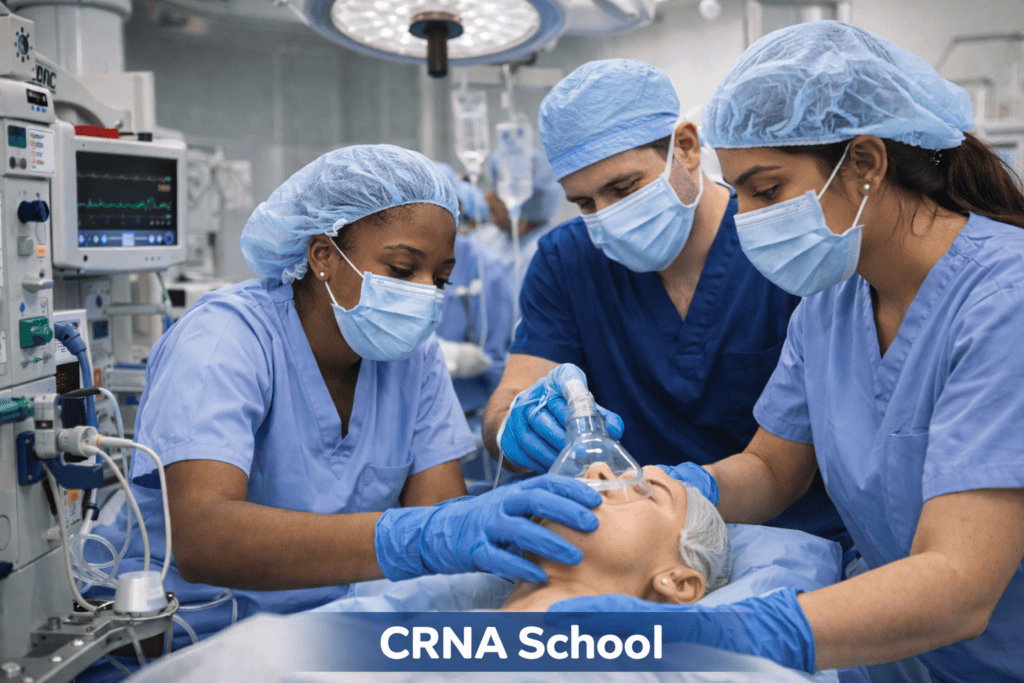
Clinical rotations occur across multiple Bon Secours Mercy Health facilities, providing broad experience:
Primary Sites:
- St. Elizabeth Youngstown Hospital
- St. Elizabeth Boardman Hospital
- St. Joseph Warren Hospital
- The Surgery Center Howland
- Akron Children’s of the Mahoning Valley
Additional Rotation Sites:
- Akron Children’s Hospital Main Campus (Akron)
- Edgewood Surgical Hospital (Transfer, PA)
- Crystal Clinic Orthopedic Hospital (Montrose and Embassy, Akron)
- Heritage Valley Beaver (Beaver, PA)
- Southwoods Health (Boardman)
- Louis Stokes Cleveland VA Medical Center (Cleveland)
Clinical Experience Breadth
Students gain hands-on experience across the full spectrum of anesthesia practice:
Surgical Specialties:
- Major cardiac surgery
- Thoracic procedures
- Peripheral vascular surgery
- Neurosurgical cases
- General surgery
- Obstetrics
- Pediatrics (including neonatal)
- Outpatient procedures
Techniques and Skills:
- General anesthesia
- Neuraxial anesthesia (spinals, epidurals)
- Peripheral nerve blocks
- Monitored anesthetic care
- Invasive line placement
- Difficult airway management
- All age groups across the lifespan
All clinical work is supervised by CRNAs and staff anesthesiologists from Bel-Park Anesthesia Associates, Inc., ensuring students learn from experienced practitioners in real-world settings.
NCE Preparation Built-In
The program includes robust certification exam preparation:
- In-program review course in final semester
- Practice certification exam
- Regular practice tests throughout final year
- Self Evaluation Exam (SEE) required with minimum passing score
- Structured approach to identifying and addressing knowledge gaps
This systematic preparation contributes to the program’s 100% first-time NCE pass rate.
Living in Youngstown During CRNA School
Affordable Cost of Living
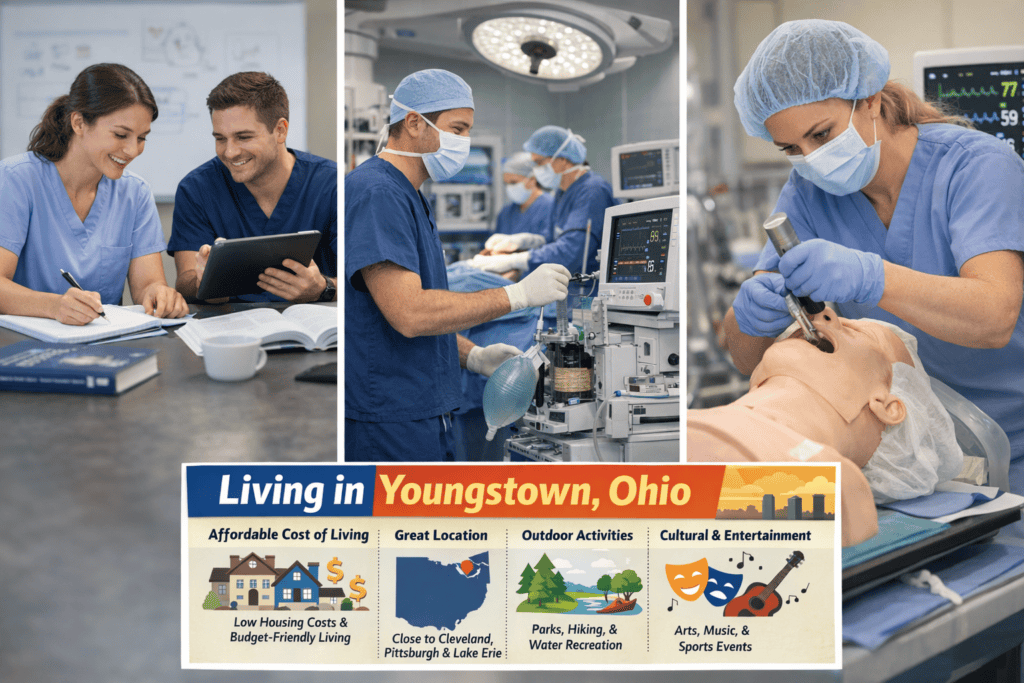
Youngstown offers one of the most affordable living situations in Ohio, helping offset education costs:
Typical Monthly Expenses:
- 1-bedroom apartment: $700-$900
- Utilities (electric, gas, water): ~$120
- Groceries: Below national average
- Gas: Typically competitive regional pricing
- Internet/cable: ~$80-$100
Recommended Neighborhoods for Students
Boardman (Most Popular)
- Newer apartment developments
- 15-minute commute to St. Elizabeth hospitals
- Shopping, restaurants readily accessible
- Generally considered safest option
Austintown
- Good value for money
- Family-friendly if you have dependents
- Solid school districts
- 20-minute commute to clinical sites
Downtown Youngstown
- Urban living experience
- Walking distance to some clinical sites
- More affordable but research specific areas carefully
- Growing revitalization efforts
Quality of Life Considerations
Advantages:
- Short commutes (rarely over 20 minutes)
- Minimal traffic stress
- Affordable entertainment (hockey, baseball, local events)
- Close to larger cities: Cleveland (60 min), Pittsburgh (70 min)
- Low overall cost of living stretches student budgets
Considerations:
- Smaller city with less nightlife than Cleveland or Columbus
- Lake effect snow can be significant in winter
- Some areas require careful neighborhood research
- Limited public transportation
Weather Reality: Youngstown experiences four distinct seasons, including cold, snowy winters due to lake effect from Lake Erie. Plan for winter driving and appropriate clothing.
Post-Graduation Career Outlook
Strong Employment Outcomes
The Class of 2025’s 100% employment within six months reflects strong regional demand for CRNAs. The program’s established relationships with healthcare systems throughout Ohio and Western Pennsylvania create natural employment pipelines.
Ohio CRNA Salary Expectations
Current market data (2025-2026) shows competitive compensation for CRNAs in Ohio:
Statewide Averages:
- Average annual salary: $202,470-$236,110
- Hourly rate: $97-$114 per hour
- Entry-level (0-1 year): ~$130,000-$135,000
- Experienced CRNAs (8+ years): $240,000-$270,000+
Regional Variations:
- Cleveland area: ~$236,000 average
- Columbus area: ~$236,000 average
- Cincinnati area: ~$235,000 average
- Rural areas: Often higher due to recruitment needs
National Context:
- National median CRNA salary: $223,210
- Ohio salaries approximately 7% below national average
- However, Ohio’s cost of living is 8% below national average
- When adjusted for cost of living, Ohio CRNAs earn competitively
Employment Settings
Graduates find opportunities across diverse practice settings:
- Hospital employment – most common path, includes benefits
- Anesthesia groups – often higher compensation, variable benefits
- Surgery centers – growing sector, regular schedules
- Pain management clinics – alternative to traditional OR work
- Locum tenens – temporary assignments, flexibility, higher hourly rates
Career Advancement Paths
Alumni from the St. Elizabeth/YSU partnership program have progressed into:
- Chief CRNA positions
- Anesthesia department leadership
- CRNA education and faculty roles
- Hospital administration
- Specialized practice areas (cardiac, pediatric, pain management)
Is This CRNA School Right for You?
This Program Excels For Students Who:
- Value hands-on learning – you’ll be in clinical settings from the beginning
- Thrive with close faculty relationships – smaller cohorts mean personal attention
- Want mentorship-based education – apprenticeship model with practicing CRNAs
- Prefer practical over purely academic focus – emphasis on clinical excellence
- Are comfortable in Ohio/Western PA – regional job market focus
- Can fully commit – demanding 36-month program requires dedication
- Appreciate proven outcomes – recent 100% pass and employment rates speak volumes
Consider Other Programs If You:
- Need to work during school – program intensity makes this extremely difficult
- Require extensive research opportunities – focus is clinical, not research-heavy
- Prefer large city amenities – Youngstown is a smaller city
- Want complete anonymity – smaller program means everyone knows you
- Need simulation-heavy training – this program emphasizes real OR experience
- Have inflexible geographic constraints – rotations span Northeast Ohio and Western PA
Frequently Asked Questions
How much does the St. Elizabeth/YSU CRNA program cost?
Tuition and fee information is not publicly listed on the school’s website. Contact St. Elizabeth School for Nurse Anesthetists directly at (330) 941-4200 or visit ytowncrnaschool.com for current tuition rates, fees, and total cost of attendance estimates. Financial aid is administered through Youngstown State University.
What GPA is required?
Minimum 3.0 cumulative undergraduate and 3.0 in science courses. However, competitive applicants typically have GPAs of 3.5 or higher.
When is the application deadline?
Applications accepted annually May 1st through July 31st via NursingCAS. Apply to St. Elizabeth first, then to YSU if accepted.
Is the program accredited?
Yes, by the Council on Accreditation of Nurse Anesthesia Educational Programs (COA). Verify current accreditation status at www.coacrna.org.
What is the NCE pass rate?
The Class of 2025 achieved a 100% first-time pass rate. Historical rates should be verified directly with the school.
How many students are accepted each year?
Contact the school for current class size information. The program maintains smaller cohorts to ensure individualized attention.
Can I work during the program?
The program is extremely intensive and full-time. Working is generally not feasible, especially during clinical years.
Are all clinical sites in Youngstown?
No. While primary sites are in the Youngstown area, rotations extend to Akron, Cleveland, and Western Pennsylvania facilities, providing diverse experience.
Are there other CRNcA Schools?
There are over 120 CRNA Schools in the USA, and if you want to search them all and compare, go to CRNA Schools by State.
Financial Planning Resources
Funding Your CRNA Education
Federal Aid Options:
- Federal Direct PLUS loans for graduate students
- Additional loan options available
- Financial aid processed through YSU Financial Aid Office
- Complete FAFSA at fafsa.ed.gov
Scholarship Opportunities:
- AANA Foundation scholarships (apply after 6 months in program)
- Ohio Association of Nurse Anesthetists awards
- State nursing association scholarships
- Hospital educational partnerships
- Military healthcare professional scholarships (Army, Navy, Air Force options)
Employment-Based Funding:
- Some anesthesia groups offer tuition reimbursement for commitment
- Hospitals may provide educational support for future employment agreement
- Be cautious with binding contracts—understand all terms before signing
Financial Planning Steps
- Contact the school at (330) 941-4200 for complete cost breakdown
- Meet with YSU financial aid to understand federal loan options
- Research scholarships through AANA and state nursing associations
- Calculate living expenses – use Youngstown cost of living data
- Create three-year budget including all program and personal expenses
- Understand loan repayment options before committing to borrowing
Ohio CRNA Job Market Analysis
Current Employment Landscape
Ohio’s healthcare market shows strong demand for CRNAs across multiple settings:
Major Employers:
- Cleveland Clinic Health System
- Ohio Health (Columbus)
- Cincinnati Children’s Hospital
- University Hospitals (Cleveland)
- Mercy Health Systems
- Summa Health
- OhioHealth
- Regional hospital systems statewide
Market Trends:
- Projected 45% employment growth for CRNAs 2019-2029 (pre-pandemic data)
- Ongoing shortage of anesthesia providers, particularly in rural areas
- Growing surgery center sector creating new positions
- Increased autonomy for CRNAs in many practice settings
- Telemedicine integration creating emerging roles
Competitive Advantages
St. Elizabeth/YSU graduates benefit from:
- Program’s 75+ year reputation in the region
- Established relationships with Mercy Health system
- Alumni network throughout Northeast Ohio
- Bel-Park Anesthesia Associates connections
- Clinical site exposure creating employment leads
Key Takeaways
- Established excellence since 1947 – St. Elizabeth School for Nurse Anesthetists has decades of proven success
- Outstanding recent outcomes – Class of 2025 achieved 100% NCE pass rate, 0% attrition, 100% employment
- Unique cooperative structure – combines hospital-based clinical immersion with university academic credentials
- Comprehensive clinical experience – rotations across 10+ facilities in Northeast Ohio and Western PA
- Strong regional employment – graduates enter an Ohio job market with growing demand and competitive salaries
Resources and Contact Information
Compare Ohio CRNA Schools:
- All Ohio CRNA Programs Overview
- CRNA Prerequisites for Ohio
- Ohio CRNA Program Costs
- Ohio CRNA Salary Data
Professional Organizations:
- Council on Accreditation (COA) – 224-275-9130
- American Association of Nurse Anesthesiology (AANA)
- Ohio Association of Nurse Anesthetists
- National Board of Certification and Recertification (NBCRNA)
St. Elizabeth/YSU CRNA Program Contact:
- Official School: St. Elizabeth Health Center School for Nurse Anesthetists, Inc.
- University Partner: Youngstown State University
- Director: John M. Underwood, DNAP, APRN-CRNA
- Phone: (330) 941-4200
- Program Director Email: underwood@belpark.net
- General Email: schoolinfo@belpark.net
- Address: Cushwa Hall 3410, 1 Tressel Way, Youngstown, OH 44555
- Website: ytowncrnaschool.com
- YSU Graduate School: ysu.edu/graduate-school
Application Portal: NursingCAS – applications accepted May 1 through July 31 annually
Important Note: You must apply to and be accepted by St. Elizabeth School for Nurse Anesthetists FIRST, then apply separately to Youngstown State University College of Graduate Studies. Acceptance into the DNP program requires admission to both institutions.
Disclaimer: All information provided is for educational purposes only. Admission requirements, program details, tuition, and outcomes data are subject to change. Verify all information directly with St. Elizabeth Health Center School for Nurse Anesthetists and Youngstown State University before making decisions. Last updated: January 2026.