
Last updated: April 2026
The Ohio University CRNA School — formally the Ohio University-OhioHealth Grant Medical Center BSN-to-DNP Nurse Anesthesia Program — is one of the newest entry-level nurse anesthesia programs in Ohio. Built through a partnership between Ohio University’s College of Health Sciences and Professions and OhioHealth Grant Medical Center in Columbus, the program leads BSN-prepared registered nurses to the Doctor of Nursing Practice (DNP) and CRNA eligibility in 36 months.
This guide is written for BSN-prepared ICU nurses who want to become CRNAs. It covers admissions requirements for the Fall 2026 cohort, the curriculum format, clinical sites, tuition, the application timeline (the December 8, 2025 deadline is just weeks away), and how Ohio University compares with other CRNA schools in Ohio.
Note: Practicing CRNAs looking for a post-master’s DNP completion option will not find one here — Ohio University does not currently offer a master’s-to-DNP completion track. This page is focused on the entry-level BSN-to-DNP program.
Ohio University CRNA School: By the Numbers
A snapshot of the program’s most-asked stats for the Fall 2026 cohort:
- 36 months — program length (full-time only, no part-time pathway)
- 9 consecutive semesters — academic structure
- 2,300 hours — total clinical/practicum requirement
- Up to 25 students — maximum cohort size, admitted once per year
- 100+ applicants — anticipated each cycle
- 50–60 interviews — anticipated each cycle (~20–25% admit rate)
- 3.20 — published minimum cumulative GPA
- 3.4–4.0 — anticipated GPA range of admitted students
- 2–6 years — anticipated critical-care experience of admitted students
- 11 clinical sites — OhioHealth network plus Ohio State Wexner, Adena, Nationwide Children’s, and Premier Health
- $107,836–$109,204 — estimated total program tuition (resident/non-resident)
What Is the Ohio University-OhioHealth Grant Medical Center CRNA Program?
The Ohio University BSN-to-DNP Nurse Anesthesia Program is a partnership between Ohio University’s College of Health Sciences and Professions (with on-campus instruction at the Ohio University Dublin Integrated Education Center) and OhioHealth Grant Medical Center, a Level I trauma center in downtown Columbus. Students complete the academic and DNP coursework through Ohio University while OhioHealth and its partner hospitals provide the clinical training network across central Ohio and the Dayton region.
Graduates earn the Doctor of Nursing Practice (DNP) degree with a Nurse Anesthesia concentration and become eligible to sit for the National Certification Examination (NCE) administered by the National Board of Certification and Recertification for Nurse Anesthetists (NBCRNA). The program is accredited by the Council on Accreditation of Nurse Anesthesia Educational Programs (COA) and meets or exceeds COA’s minimum academic and clinical requirements.
Admissions Requirements for Ohio University CRNA School
Ohio University looks for high-acuity ICU nurses who can handle a fast-paced doctoral program. The published minimums are reasonable, but admitted students typically present credentials well above the floor. Here is what you need to be a competitive applicant for the Fall 2026 cohort:
Required Credentials
- Bachelor of Science in Nursing (BSN) from a regionally accredited institution, awarded by the application deadline
- Active, unrestricted RN license in the U.S. with the ability to practice in Ohio
- Minimum cumulative GPA of 3.20 (published floor); admitted students average 3.4 to 4.0
- Two years of full-time RN experience within the past 5 years, including at least 1 year of full-time adult ICU experience within the last 3 years by the application deadline
- CCRN certification required by the application deadline (a scheduled exam date is not acceptable)
- Current AHA ACLS card with expiration date
- Three letters of recommendation — at least two from individuals prepared at the graduate level, with at least one from an APRN or RN
- Professional Goals Statement in APA 7th edition, no more than three pages, citing the AACN Essentials and/or APRN Consensus Model where appropriate
- Detailed professional resume documenting RN work history with start/end dates
- Shadow experience with a CRNA is strongly recommended
Note: The GRE is not required. Ohio University also does not accept transfers from other CRNA programs except on an individualized basis, and there is no master’s-to-DNP completion option for current CRNAs.
Average Critical-Care Experience of Admitted Students
Ohio University publishes that admitted students typically present 2 to 6 years of critical-care experience. The 1-year ICU minimum gets you to the application threshold; the average admit is well above it.
What Counts as ICU Experience?
Ohio University defines critical care narrowly.
Acceptable units are adult intensive care settings where you independently manage invasive monitoring, titration of vasoactive infusions, ventilated patients, and acutely ill patients.
The following do not count toward the ICU requirement: operating room, emergency department, cardiac catheterization lab, and telemetry.
Flight nursing experience is accepted only if the applicant also has at least one year of full-time ICU experience within the last three years and actively manages patients on ventilators and vasoactive drips during transports.
Note: If your only critical-care experience is in the ED, cath lab, or step-down, plan to transition into a true ICU role for at least a year before the application deadline. This is one of the most common reasons strong applicants are screened out.
How to Apply to Ohio University CRNA School
Application Timeline
The program admits one cohort per year for an August (Fall 2026) start. Two key dates for the upcoming cycle:
- December 8, 2025 — application submission deadline (end of business day)
- December 12, 2025 — hard stop for all application materials to be received and complete
Verify the exact dates for future cycles directly on Ohio University’s official admissions page before applying — some materials must be ordered or scheduled weeks in advance.
Application Components
- Online graduate application through Ohio University
- Official transcripts from every college attended (sent directly from the issuing institution to the Graduate College)
- Three letters of recommendation submitted through Ohio University’s online recommendation portal
- Professional Goals Statement in APA 7th edition (max three pages)
- Detailed professional resume
- Proof of current AHA ACLS card (with expiration date)
- Proof of CCRN certificate (with expiration date)
- Current, valid, unrestricted Ohio RN license number
- Application fee
The Interview
Applicants who advance are invited to an interview. Ohio University emphasizes authenticity over rehearsed jargon, but expect a clinical knowledge component, behavioral questions, and a faculty panel.
Strong preparation in pharmacology, hemodynamics, and ventilator management is essential, as is a clear articulation of your professional goals and your understanding of the CRNA scope of practice.

Ohio University CRNA School Acceptance Rate
Ohio University does not publish a formal acceptance rate, but the funnel each cycle is well documented. The program anticipates more than 100 applicants, invites 50 to 60 candidates for interviews, and matriculates a cohort of up to 25 students.
That puts the effective admit rate in the 20 to 25 percent range — competitive but achievable for an applicant who clears the 3.20 GPA floor (and ideally lands in the 3.4–4.0 admit range), has 2+ years of ICU experience, holds CCRN, and interviews well.
Curriculum and Program Format
Ohio University describes the program as a hybrid format: DNP core courses are delivered online (primarily asynchronous, with some expected synchronous sessions), and all nurse anesthesia didactic coursework is conducted in the classroom at the Ohio University Dublin Integrated Education Center or the OhioHealth Grant Medical Center Education Center. Nurse anesthesia classes meet Monday through Friday during the day, and clinical experiences begin in Year 2.
Note: Important: Ohio University states that students cannot work during this program due to the curricular and clinical demands. Plan your finances accordingly before you apply.
Year 1 – Foundation
The first year covers the DNP core (research methods, evidence-based practice, health policy, leadership) along with foundational nurse anesthesia didactic: advanced anatomy and physiology, advanced pharmacology, biochemistry for anesthesia, and an introduction to anesthesia principles. DNP core coursework is online and asynchronous; nurse anesthesia didactic is in the classroom.
Year 2 – Clinical Integration
Clinical rotations begin in Year 2. Coursework moves into specialty anesthesia content — obstetric, pediatric, cardiothoracic, neuro, regional, and pain — paired with progressive clinical experiences across OhioHealth and partner sites.
Students log cases under CRNA and physician anesthesiologist preceptors. Clinical and practicum experiences are typically Monday through Friday but may include evenings, weekends, nights, and holidays, including emergent case experience.
Year 3 – Residency and DNP Project
The final year is dominated by full-time clinical residency rotations and completion of the DNP scholarly project. Students rotate through subspecialty services, take call, and refine independent practice skills before graduation.
Total clinical exposure is approximately 2,300 hours. All coursework must be completed within the 36-month program of study.
High-Fidelity Simulation
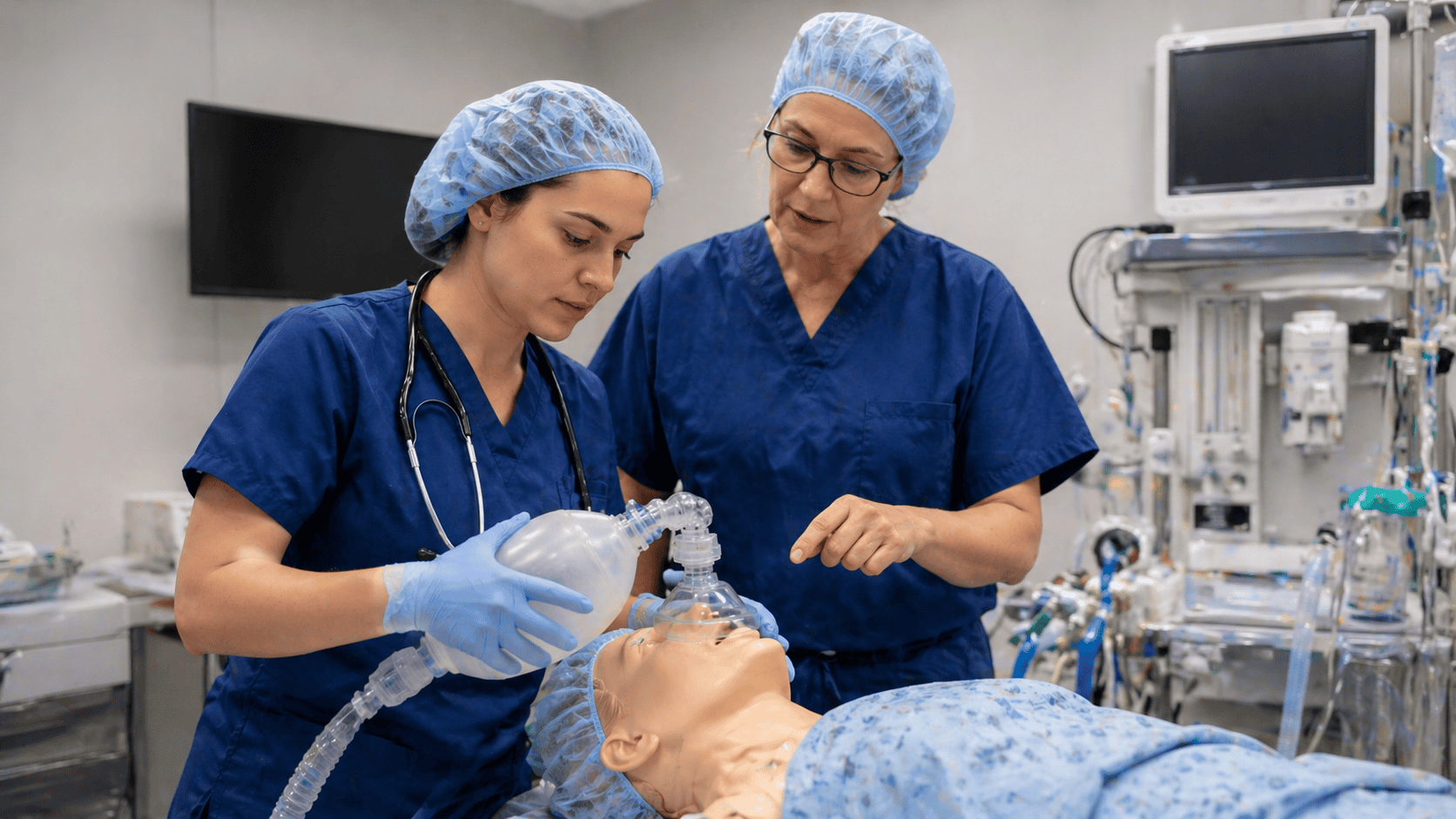
Before students reach the operating room, they spend significant time in high-fidelity simulation labs at the Dublin campus practicing airway management, regional techniques, and crisis-resource management.
Clinical Sites and the OhioHealth Partnership
The clinical training network is one of the program’s biggest strengths. The anchor site is OhioHealth Grant Medical Center, a Level I trauma center in downtown Columbus that exposes residents to high-acuity trauma, neurosurgery, vascular, and emergency anesthesia cases.
Clinical experiences include elective and emergent procedures, call experience, OB, cardiac, ICU, regional, pediatric, and rural rotations.
The full clinical rotation network includes:
- OhioHealth Grant Medical Center (Level I trauma) – Columbus
- OhioHealth Riverside Methodist Hospital – Columbus
- OhioHealth Dublin Methodist Hospital – Dublin
- OhioHealth Doctors Hospital – Columbus
- OhioHealth Marion General Hospital – Marion
- OhioHealth O’Bleness Hospital – Athens
- The Ohio State University Wexner Medical Center – Columbus
- Adena Regional Medical Center – Chillicothe
- Nationwide Children’s Hospital – pediatric anesthesia rotation
- Premier Health Miami Valley Hospital – Dayton
- Upper Valley Medical Center – Troy
This range gives residents exposure to academic medical centers, Level I trauma, community hospitals, and dedicated pediatric and obstetric services without leaving Ohio.
Tuition and Cost of Attendance
Ohio University publishes per-credit and total program costs for the BSN-to-DNP Nurse Anesthesia track. Figures below reflect the most recent published estimates and should be verified on Ohio University’s official tuition page before you finalize a financial plan.
Estimated Program Tuition (2026)
- Ohio resident: approximately $1,253 per credit, ~$107,836 total
- Non-resident: approximately $1,272 per credit, ~$109,204 total
Itemized Additional Fees (~$4,429 total)
- ACLS recertification – $200
- PALS certification – $225
- AANA Associate member dues – $200
- Typhon Nurse Anesthesia Student Tracking System – $100
- SEE examination fee – $280
- Certification examination (“Boards”) – $1,100
- Nurse Anesthesia textbooks – $1,000
- Malpractice insurance (required 2 years) – $275
- Apex Anesthesia (3-year subscription) – $499
- Ohio State Wexner Medical Center clinical site parking – $100
- Clinical site mileage – variable
- Prodigy Anesthesia (2-year subscription) – OPTIONAL $450
Students should also budget for living expenses in Columbus, Athens, or Dublin, AANA student membership beyond required dues, scrubs and equipment, and travel between clinical sites. Most students finance their education through federal Direct Unsubsidized and Graduate PLUS loans; remember that Ohio University does not allow students to work during the program, so plan a full living budget for 36 months.
Program Outcomes: Attrition, NCE Pass Rate, and Employment
Because Ohio University’s BSN-to-DNP Nurse Anesthesia Program is new, the program does not yet have graduates, and there are no published 5-year attrition, employment, or first-time NCE pass rates available at the time of this update. Once the inaugural cohort sits for the National Certification Examination, those metrics will be added to the program’s public outcomes disclosure as required by COA.
How the Program Prepares Students for Boards
Even without published pass rates, Ohio University has built structured exam preparation into the curriculum.
Students take the Self-Evaluation Examination (SEE) twice during the program to identify knowledge gaps. The final year includes an in-program practice certification exam and additional practice tests to build readiness for the NCE.
Until published outcome data exists, prospective applicants should evaluate the program on its accreditation status, clinical site network, faculty experience, and class-size to faculty ratio. Ask current students and faculty about exam preparation support and the program’s response when students struggle academically.
How Ohio University Compares to Other Ohio CRNA Schools
Ohio University is one of seven currently accredited entry-level CRNA programs in Ohio. Each has a distinct flavor, and the right fit depends on your clinical interests, geography, and budget.
| Program | Length | Cohort Size | Format / Location |
|---|---|---|---|
| Ohio University – OhioHealth Grant | 36 mo / 9 sem | Up to 25 | Hybrid; Dublin/Columbus |
| The Ohio State University | 36 mo | ~25–30 | On-campus; Columbus |
| University of Cincinnati | 36 mo | ~30 | On-campus; Cincinnati |
| Cleveland Clinic (FPB-CCF) | 36 mo | ~12–15 | On-campus; Cleveland |
| University of Akron | 36 mo | ~20 | On-campus; Akron |
| Otterbein University | 36 mo | ~20 | On-campus; Westerville |
| Lourdes University | 36 mo | ~12–15 | On-campus; Sylvania/Toledo |
| Youngstown State University | 36 mo | ~12–15 | On-campus; Youngstown |
Each school has its own clinical network and admissions priorities. Use the links below to read program-specific deep dives:
- The Ohio State University CRNA School – large academic medical center, deep subspecialty exposure, very competitive admissions
- University of Cincinnati CRNA School – long-established program with a strong Level I trauma footprint
- University of Akron CRNA School – northeast Ohio location, partnership with Cleveland Clinic Akron General
- Youngstown State University CRNA School – smaller cohorts, Mahoning Valley clinical sites
- Otterbein University CRNA School – newer Columbus-area program with OhioHealth partnership
- Lourdes University CRNA School – northwest Ohio (Toledo) program with Mercy Health partnership
- Cleveland Clinic CRNA School – Frances Payne Bolton/Case Western partnership at Cleveland Clinic
See the full list of CRNA schools in Ohio for side-by-side details, or browse CRNA schools by state to compare programs nationally.
Is Ohio University CRNA School Right for You?
Strengths
- Robust OhioHealth clinical network anchored by a Level I trauma center
- Smaller cohort size (up to 25) means more individual faculty attention
- DNP core delivered online and asynchronously — friendly to ICU nurses balancing transition obligations before classes start
- All anesthesia didactic stays in the classroom — face-to-face instruction during the most technically demanding content
- Built-in SEE testing twice during the program plus in-program practice NCE
- Strong central Ohio job market for new CRNAs
- Nationwide Children’s for pediatric exposure, Adena Regional for rural anesthesia variety, and Premier Health for Dayton-region rotations
Considerations
- No published outcomes yet — you are betting on the program rather than historical metrics
- Full-time only; no part-time pathway, and students cannot work during the program
- Geography is split between Athens, Dublin, Columbus, and Dayton clinical sites — plan for travel and possible relocation
- Tight ICU-experience definition rules out OR, ED, cath lab, and telemetry hours
- No dedicated CRNA scholarships; most students rely on federal loans
- No master’s-to-DNP completion option for current CRNAs
Frequently Asked Questions
How long is the Ohio University CRNA program?
The program is 36 months / 9 consecutive semesters, full-time, with one Fall (August) start per year and no part-time option.
What is the minimum GPA for Ohio University CRNA School?
The published minimum cumulative GPA is 3.20. Admitted students typically present a GPA in the 3.4 to 4.0 range, with strong grades in science prerequisites.
How much ICU experience do I need to apply?
A minimum of 2 years of full-time RN experience within the past 5 years, including at least 1 year of full-time adult ICU experience within the last 3 years by the application deadline. CCRN certification is also required by the application deadline.
Does Ohio University accept ED, OR, cath lab, or telemetry experience?
No. Operating room, emergency department, cardiac catheterization lab, and telemetry do not count toward the ICU requirement.
Flight nursing experience is accepted only when paired with at least one year of full-time ICU experience within the last three years.
Can I work during the program?
No. Ohio University states that students cannot work during the program due to curricular and clinical demands.
Plan a full living budget for 36 months before applying.
Is the GRE required?
No. The GRE is not required for admission to the Ohio University BSN-to-DNP Nurse Anesthesia Program.
Is the program online?
No. Ohio University describes the format as hybrid — DNP core coursework is delivered online (mostly asynchronous, with some synchronous sessions) but all nurse anesthesia didactic is conducted in the classroom at the Dublin or OhioHealth Grant education centers, and clinical rotations are on-site across the OhioHealth network.
How much does Ohio University CRNA School cost?
Estimated total program tuition is approximately $107,836 for Ohio residents and $109,204 for non-residents (around $1,253–$1,272 per credit), plus about $4,429 in itemized additional fees (ACLS recert, PALS, AANA dues, SEE exam, board exam, textbooks, malpractice, and clinical-site costs). Verify current rates on the Ohio University tuition page before applying.
When is the Fall 2026 application deadline?
Applications must be submitted by end of business on December 8, 2025, and all materials must be received and complete by December 12, 2025. Confirm dates each cycle on Ohio University’s official admissions page.
Does Ohio University offer a master’s-to-DNP completion program for current CRNAs?
No. Ohio University currently offers only the entry-level BSN-to-DNP Nurse Anesthesia Program.
Practicing CRNAs seeking a post-master’s DNP should look at other programs that offer that pathway.
Next Steps for Aspiring CRNAs
If Ohio University is on your shortlist for Fall 2026, here is what to do next:
- Confirm your ICU role meets the program’s critical-care definition; if not, transition to a qualifying ICU now
- Sit for the CCRN exam well before the December 8, 2025 application deadline
- Shadow a CRNA in person and document the experience
- Strengthen science prerequisite grades if needed; retake any course graded below a B
- Build relationships with graduate-level recommenders — at least one APRN or RN — who can write detailed, specific letters
- Draft your Professional Goals Statement in APA 7th edition, citing the AACN Essentials and APRN Consensus Model
- Read the official Ohio University admissions page end-to-end and download the program brochure
- Compare with the rest of the CRNA schools in Ohio before finalizing where to apply
Not sure where to start? Our How to Become a CRNA guide walks you through every step from BSN to certified registered nurse anesthetist.
Have a question we did not answer here? Get in touch and we will help.